Heavily armed members of the Bolivian military, entering on foot and via armored vehicles, swarmed a town square near the center of government in the country’s capital of La Paz yesterday for a brief while.
They were joined almost immediately in their action by members of the country’s national police force, who appeared to side with them on whatever it was they were attempting.
They came without warning, and without much explanation as to what they were about to do. Though the seizing of that critical territory was brief, it was for that short time terrifying.
Those armed forces were led by General Juan Jose Zuñiga, who up until earlier this week was the commander of the Bolivian army.
Arce was elected four years ago and up to this point led a calm term of office. His policies mostly followed in the footsteps of socialist President Evo Morales, though with more emphasis on building international partnerships to grow the economy. Those include linkages with both China and Russia to help developing mining and markets for its vast lithium reserves, which are the largest in the world and in high demand for lithium-based rechargeable batteries for electric vehicles and most portable electronic devices everywhere.
Zuñiga’s forces made it into the town square and, with the help of armored vehicles and large numbers of troops, eventually breached the Palacio Quemado, the main official palace in La Paz and Arce’s official government quarters.
As the opposition army broke into the palace, Arce, not knowing precisely how deep what clearly appeared to be an attempt to overthrow his government might have already spread, issued executive orders naming new commanders of the Army, Navy, and Air Force, to secure his position of authority.
Zuñiga and his troops made it further onto the palace grounds.
As the former general made it far enough in to believe his coup might succeed, he was spoke briefly to the press about what just happened. He said what he and his rebel forces hoped to accomplish by their action was “to restore democracy” in the nation.
“We are listening to the cry of the people because for many years an elite has taken control of the country,” he continued.
Without identifying President Arce by name, Zuñiga called out the current group of politicians in charge in Bolivia were “destroying the country”. He asked those listening to “look at what situation we are in, what crisis they have left us in.”
He went on to insist that the “armed forces” he had brought in for yesterday’s attempted overthrow “intend to restore the democracy, to make it a true democracy.”
Videos released from the scene depicted a heated face-to-face confrontation between Zuñiga and President Arce, in which Arce demanded Zuñiga stand down. Initially Zuñiga refused, and for some moments it appeared the former general might take Arce hostage and seize the palace as his own.
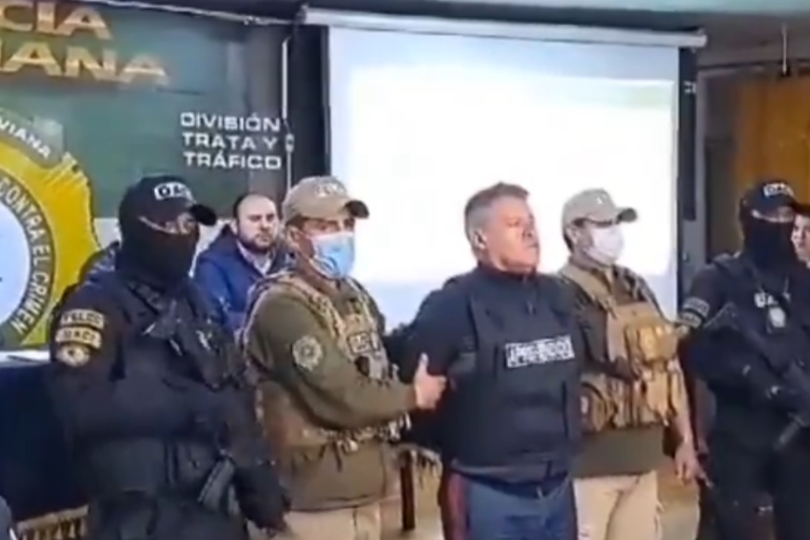
Eventually he did stand down, after Arce and his senior staff refused, and apparently Zuñiga did not want to add kidnapping and violence to the charges which will likely soon be brought against him over what happened yesterday. The former military commander was taken into custody by Bolivian police soon after the attempted government takeover was put down. Former navy Vice Admiral Juan Arnez Salvador, an ally of Zuñiga who also participated in the coup attempt, was also arrested at the same time.
As background to all that just took place this week, Zuñiga was originally appointed to his post by President Arce in November 2022.
He moved into that position after a long-time career in the country’s military, with his first very senior position coming in 2012 when he was promoted to colonel of Bolivia’s REIM-23 Max Toledo regiment. It was during his two-year tenure in that role that Zuñiga was charged and found guilty of embezzling 2.7 million Bolivian bolivianos (equivalent in 2024 value to about U.S. $385,000) which was supposed to go to Renta Dignidad and Jacinto Pino. He served only seven days in jail for that, and his crime was largely forgotten.
Zuñiga’s tenure as the senior military commander for Bolivia seemed to be running smoothly, until apparently out of nowhere on June 24 he made an odd proclamation regarding the upcoming 2025 presidential election in the country. He declared on that day that if former Bolivian President Evo Morales were to run again for office in 2025, as most believe he probably will, Zuñiga would arrest him.
Morales had previously been banished from the country in 2019 after being ousted by what his supporters said was a U.S.-led coup. That coup, led by a right-wing president, lasted just one year, when the socialist leader Arce became president in 2020.
In the accusations made Monday against the former president, Zuñiga said Morales had already attempted his own coup attempt in the country even while Arce was in charge. He said Morales was the secret leader of the Pachajcho military organization, which was itself allegedly aligned with local coca producers and political factions aligned against Arce.
As part of his unexpected public outrage against Morales on June 24, Zuñiga called Morales a “traitor” to the nation.
Soon the then Commander of the Bolivian Army was fired by President Arce, probably for having overstepped his role and undermining Arce’s authority.
Once Arce had Zuñiga out of the Palacio Quemado, he immediately issued orders to all members of the military, via his newly appointed heads of the Army, Navy, and Air Force, to remove themselves from Plaza Murillo and other grounds nearby, and return to their barracks immediately.
He announced the orders for those troops while flanked by José Wilson Sánchez Velásquez
The opposition military were all dispersed in just two hours.
“Today the country faces, once again, interests in toppling Bolivian democracy,” Arce said in a video statement released from the Great House of the People, his official residence in La Paz, even as he and others were still under siege. He was surrounded by his cabinet ministers as he spoke.
There he called on the people of Bolivia to throw their full support in rejecting this attempt to overthrow the legitimate government of the country.
“We need the Bolivian people to mobilize and organize themselves against this coup d’état and in favor of democracy,” he said. “We cannot allow, once again, attempted coups to claim Bolivian lives.”
His ministers cheered him on in the video, declaring, “Long live the people of Bolivia! Long live democracy!” and “Long live our president, Luis Arce!”
In a separate video message, Foreign Minister Celinda Sosa Lunda warned the country’s citizens that opposition military forces had attempted a violent threat against Bolivia’s “democracy, peace and national security”.
“We denounce to the international community that a coup attempt against our democratically elected government” took place, Bolivian Vice-President David Choquehuanca wrote in a social media post on X after Zuñiga’s forces had already left downtown La Paz.
Former President Evo Morales also called for the citizens of Bolivia to stand up to protect their country from this serious threat from the former general and the armed forces he had marshalled into La Paz.
“We will not allow the armed forces to violate democracy and intimidate the people,” Morales wrote in his own social media post.
Outside the country, there was strong support for Arce’s democracy and none for Zuñiga’s rogue contingents.
Luis Almagro, the Secretary General of the Organization of American States, said his organization would never accept “any kind of rupture of the legitimate constitutional order in Bolivia” such as what Zuñiga just attempted.
Claudia Sheinbaum, Mexico’s president-elect, categorized the military uprising as an “attack against democracy”, and pledged “our unconditional support for President Luís Arce and his people”.
Venezuelan President Nicolás Maduro offered his full support as well, urging Bolivian citizens “to defend their democracy, their constitution and their president” over “fascism” and coup attempts like these.
For now, the situation in Bolivia is calm. But if there are others who share Zuñiga’s rage over what he sees as the disintegration of democracy from within the office of the president himself, a second coup might be closer at hand than the public realizes.