NATO Summit Promises New Air Defenses for Ukraine but Will Not Guarantee Membership
Lead StoryConflict
What those 32 nations, 30 of which are in Europe and the other two – Canada and the U.S. – are in North America, refused to do was to guarantee Ukraine member status in the organization.
The United States is the host nation for the NATO leaders’ gathering this time, with Washington, D.C. as the site for all meetings.
Embattled Joe Biden is the master of ceremonies for the occasion, an event arranged to happen in the U.S. partly in honor of its pivotal role in the original founding of NATO in 1949 and for his having pushed the alliance to stand together to defend Ukraine after Russian invaded it from the east in February 2022.
Unfortunately for him, Biden also comes to this meeting fresh from a disastrous debate performance against Donald Trump less than two weeks ago. Though evidence of his declining physical stamina in general, along with public signs of what appears to be early-stage dementia and neurological challenges, has been evident for some time, the debate showed Biden at the podium repeatedly physically freezing, slurring sentences, combining irrelevant topics together in single answers to questions posed to him, and often losing track of the sense of what he was trying to say.
Since that happened, Democratic donors and party leaders have suggested Biden needs to come clean about what is really going on with him as a minimum, and possibly to step aside for a healthier candidate to take his place in November’s presidential election.
“I think it's a legitimate question to say, is this an episode, or is this a condition?”, asked Congresswoman and Former Speaker of the House Nancy Pelosi in an interview on July 2 about the matter.
Few believed Biden would back out of the race before this week’s NATO summit, even if he had already privately agreed to let someone else run in his stead. That was because of the chaos which might ensue in reaching any major decisions there, if it were already clear Biden would not remain president.
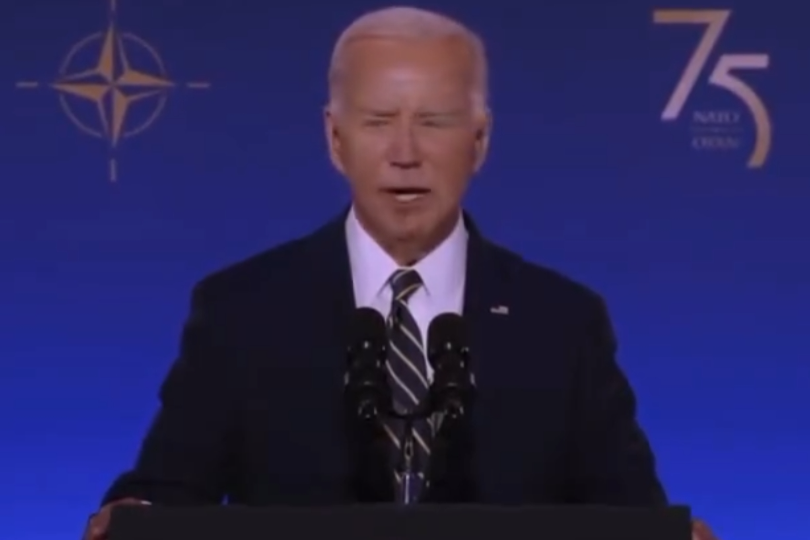
As Biden stepped up to deliver opening remarks to the NATO members yesterday, he was therefore doing so with three objectives in mind. The first was to congratulate the alliance for surviving for 75 years despite its original reason for existence – to repel the threat of the Soviet Union – now long gone. Second was to declare the alliance’s strong backing for Ukraine in its war with Russia. And the third was to demonstrate to the public and the other leaders present that Biden was still mentally competent and physically able to do his job.
One day of the gathering, the jury is still out about whether Biden accomplished that third goal.
As Biden took the stage yesterday, he welcomed the members and praised them for their collection actions which made the organization more “united” than ever before. He also thanked the leadership for enabling NATO to be “better resourced than it ever has been”, with 23 of the 32 countries in NATO now contributing at least 2% of their GDP to the military alliance, up from just 9 in 2020.
He then jumped almost immediately into a major new announcement of military support for Ukraine.
He opened that topic by declaring that, “Ukraine can and will stop [Russian President] Putin, especially with our full collective support.”
“Before this war, Putin thought NATO would break,” Biden continued. “Today, Nato is stronger than it’s ever been in its history. When this senseless war began, Ukraine was a free country. Today it’s still a free country and the war will end with Ukraine remaining a free and independent country.”
“Russia will not prevail,” the president continued. “Ukraine will prevail.”
Then Biden outlined how the U.S., along with support from Germany, Italy, the Netherlands, and Romania, will be substantially enhancing Ukraine’s air defenses soon. That will be accomplished via donations of U.S.-made Patriot interceptor missile batteries and associated mobile radar and targeting systems from each of the countries. For all but Italy, actual Patriot missiles will be provided. Italian Prime Minister Georgia Meloni confirmed her country will be contributing the SAMP/T air defense systems it and France have developed together. Those are clones of the Patriot missile systems and fully compatible with installations using U.S.-built Patriots.
“These five strategic air defense systems will help to protect Ukrainian cities, civilians, and soldiers, and we are coordinating closely with the Ukrainian government so that these systems can be utilized rapidly,” the five nations said in a collective statement issued concurrent with Biden’s remarks. “We are working on a further announcement this year of additional strategic air defense systems for Ukraine.”
In addition to the Patriot missile installations, the military alliance announced it would be providing Ukraine with many additional short-range tactical aerial attack interceptor systems from multiple nations. Among those will be Hawks from the United States, Iris systems from a cross- European consortium, NASAMS produced jointly by the United States and Norway, and Gepard missiles from Germany.
“All told, Ukraine will receive hundreds of additional interceptors over the next year, helping protect Ukrainian cities against Russian missiles and Ukrainian troops facing their attacks on the frontlines,” Biden said at the conclusion of his speech to the group.
It was a strong beginning to a summit which will prove pivotal both for Ukraine as well as Biden.
It also is a time in which multiple leaderships are changing in the NATO alliance, with Keir Starmer having just taken over as Prime Minister of the United Kingdom and France’s Emmanuel Macron possibly losing his job after elections strongly favored the far right and extreme left recently. The European Union’s parliamentary elections also pointed to possible shifts in support both for Ukraine and Israel ads the summit continues.
Biden’s job too is on the line, for so many reasons.
All these changes come as NATO wrestles with yet another question: that of whether Ukraine should be guaranteed a path to full membership in the alliance.
That is a thorny subject, without full agreement from the alliance for now. The challenge for all is that as long as Russia and Ukraine remain at war, granting Ukraine membership would instantly require the 32 existing member nations besides Ukraine to prepare for war with the Russian Federation. It would no longer be a proxy war and could quickly deteriorate into a genuine World War.
After fierce debate on the topic in advance of this week’s NATO summit, members chose only to agree to support Ukraine as unilaterally as possible. They appear to have once again tabled any firm commitment to bring on Ukraine as a member, at least until the war with Russia is over and Ukraine’s firm boundaries are confirmed.