
The American business engine continues to surprise, this time with GDP growth jumping from 1.4% in Q1 to 2.8% in Q2.
That number, an “advance” estimate provided by the U.S. Bureau of Economic Analysis (BEA), roared past mean expectations of 2.0% based on a recent survey of what economists guessed might end up happening. The low end of those forecasts was just 1.1% and the high-end outlier possibility was up to 3.4%.
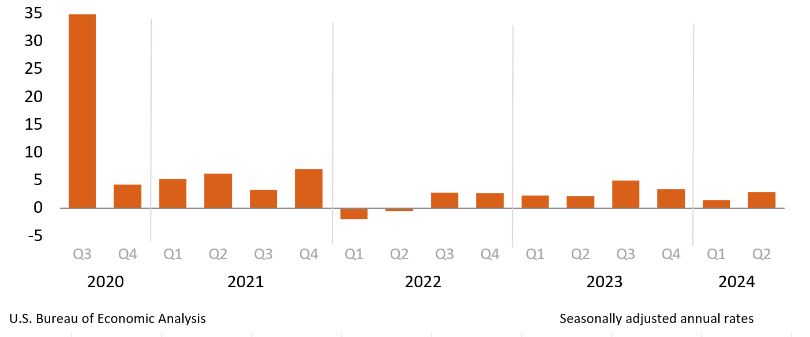
According to the BEA, the principal triggers for growth in real GDP this time were continued rises in consumer spending, plus both nonresidential as well as private inventory investments.
Consumer spending, which is responsible for slightly over two-thirds of the U.S. economy, rose this time in a broad range of items. The “goods” part of that spending was led by substantial increases in purchases in motor vehicles and associated parts. The services area showed a balanced mix of items, with health care, housing, utilities, and services associated with recreation, the latter normally an indicator of strong consumer confidence.
Residential fixed investment, which is considered part of consumer spending, dropped slightly last quarter, lowering the overall impact of the growth areas within the goods and services increases.
The private inventory component of the investment growth this last quarter came primarily from tr4ade, both wholesale and retail. There was less investment in the mining, utilities, and construction industries than in the previous quarter. The lower amount of money flowing into the construction sector could suggest some long-term easing of the economy, perhaps showing up more substantially in jobs and construction services by year-end.
The nonresidential fixed investment category of the economy saw intellectual property related expenditures and equipment buying lead this area. Structure investment was less this time, which mirrors the decline in construction in the private inventory area.
Imports increased this last quarter, with capital purchases the subcategory here which showed the largest increases. Imports of automotive products, which might seem logically to partner with the increased spending on motor vehicles and parts noted earlier, were down slightly this time.
Other factors associated with the report suggest some areas of the American economic engine which should be monitored closely in the coming months.
As an example, the BEA reported this time that current-dollar personal income growth fell from the first quarter’s $396.8 billion to just $237.6 billion. That is a 40% slide in gross personal income.
Similarly, disposable personal income growth, which is directly linked to overall personal income increases, slid from Q1’s 4.8% growth of $240.2 billion to $186.3 billion this time, which calculates out to a 3.6% rate of growth. While that number is down, the growth in disposable income is still considered strong enough to keep the economy moving forward for now.
The BEA also reports real disposable personal income, after adjustments for inflation and other factors, increased only 1.0% for the April-June quarter versus 1.3% in the first three months of the year.
Personal saving rates also declined slightly from Q1 to Q2, for a net 3.5% in the latest quarter versus 3.8% for the previous three months. The amount of money associated with that dropped from $777.3 billion in Q1 to $720.5 billion. Many factors, including separate projections that consumers are spending more to service personal consumer debt now, are responsible for this decline.
Once again, the drops in personal savings and real disposable personal incomes are, at least for now, not considered to have a serious impact on the economy for now.
As the new GDP figures were announced, Joe Biden, fresh off relieving himself of the stresses of a continued intense personal political campaign as he turned over running for the presidency to VP Kamala Harris, still could not resist using the new economic news to declare the Bureau of Economic Analysis figures to be a major win for his presidency.
In a brief message released yesterday, he spoke of his administration having created almost 16 million new jobs to date with more coming, plus supporting substantial wage gain growth and yet still bringing inflation down without a recession being needed. Unemployment also continues to run at record low levels for the country, still the best seen in 40 years.
“Today’s GDP report makes clear we now have the strongest economy in the world,” Biden said.
More good news for that economy could also be coming soon from the Federal Reserve Board.
According to Fed Chair Jerome Powell in remarks before the Senate Committee on Banking, Housing, and Urban Affairs on July 9, followed by identical ones provided the next day to the House Committee on Financial Services, described the economy as still continuing strong but without the concerning rapid increases in job growth and GDP expansion which had previously led to the Fed raising prime lending rates almost continuously for close to two years straight.
“Recent indicators suggest that the U.S. economy continues to expand at a solid pace,” he said at the time, but added that, “Gross domestic product growth appears to have moderated in the first half of this year following impressive strength in the second half of last year.”
“In the labor market,” Powell added, “a broad set of indicators suggests that conditions have returned to about where they stood on the eve of the pandemic: strong, but not overheated.”
“The unemployment rate has moved higher but was still at a low level of 4.1 percent in June,” he continued.
Further, while “inflation has eased notably over the past couple of years but remains above the Committee's longer-run goal of 2 percent,” he went on, he seemed more focused on sustaining the economy’s “resilient demand” and moderate growth in capital spending and residential investment than in pushing too hard to bring the unemployment down further.
The remarks say the Fed is probably still on track for its first prime lending rate cut in September, just as Powell had previously hinted. Assuming that happens, that could propel investments further upwards in the coming months and keep the economy growing at near its Q2 growth pace well into early 2025.
The Bureau of Economic Analysis’ final figures for second quarter growth in the U.S. will be released on August 29, 2024.