U.S. and China South China Sea Disputes Take Center Stage at ASEAN Summit
Lead StoryConflict
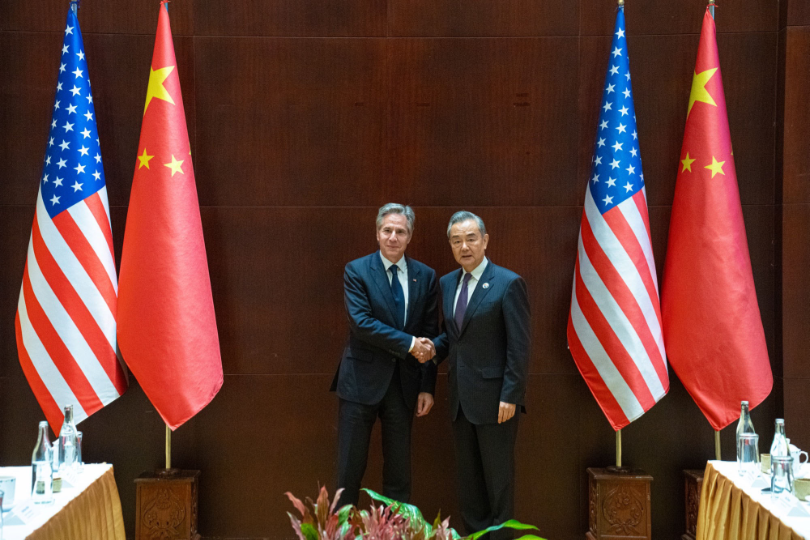
This year’s annual Foreign Ministers’ Meeting of the Association of Southeast Asian Nations (ASEAN) that concluded this weekend was held this time in Vientiane, Lao PDR, as part of a rotating host nation arrangement. Though as part of those discussion the member states of ASEAN – Brunei, Cambodia, Indonesia, Laos, Malaysia, Myanmar, the Philippines, Singapore, Thailand, and Vietnam – did end up covering hot topics of their own, much of the news which emerged from the sessions ended up focusing on verbal clashes between two of the invited guests, the United States and the People’s Republic of China (PRC).
Joining the U.S. and China at this unusual session were representatives from Russia, which had been separated from contact from this group for some time because of its invasion of Ukraine; India, which continues to navigate a more separate political path, including remaining at odds with China over its own territorial arguments along its northern Himalayan border with the PRC, continuing its long-standing amicable relationships and oil trade with Russia, and off-and-on strategic alliance and military drills with the U.S. and other western powers; and Australia, which through AUKUS is expanding its armed naval presence both around its borders and extending up into the rest of the Asia-Pacific region.
Of critical importance for the ASEAN group to discuss this time were the ongoing military conflicts in Myanmar, a long-standing member of the group, and the escalating nature of the South China Sea Dispute.
Myanmar has been engaged in a civil war since 2021. That was when on February 1st of that year a military junta overthrew the democratically elected government. The military group, headed by Commander-in-Chief, General Min Aung Hlaing, claimed extensive voter fraud in the election just months earlier which had installed Win Yint as president, and also put in 1991 Nobel Prize laureate Aung San Suu Kyi, daughter of martyred former leader Aung San, as State Counselor, the equivalent of the Foreign Minister position in other countries. The military quickly imprisoned both Aung San Suu Kyi and Win Yint, along with many senior members of the deposed administration.
Now two-a-half-years since that overthrow, the citizens who initially fought back against the military takeover and were subdued for some time have in the past year rekindled their multi-pronged attacks against the junta. Though the ASEAN group has mostly condemned the takeover, little has been done to enforce that condemnation other than for each individual country to curtail trade with the embattled nation, as a means of putting pressure on the military to at least allow for new free elections and to release the still-captive prisoners they put behind bars at the time of the coup d’etat.
Earlier this month the resistance fighters from Kachin State in Myanmar, reported the military has begun using white phosphorus and other chemical weapons to subdue those attempting to destabilize the junta. White phosphorous is the same flaming weapon which the U.S. once used against its enemies during the still-very-well-remembered days of the Vietnam War over fifty years ago, and which was long since banned for the horrific nature of the weapon, which literally rains fire from the air which sticks to clothes, hair, and flesh, melting the skin down to the bone while people die, burned alive. It is also the same chemical weapon which Israeli Defense Forces used on numerous occasions in its current war against the Palestinian people in Gaza, as a vicious war crime cited in International Criminal Court documents, and in direct violation of humanitarian law as occupying forces.
For Myanmar as a whole, thanks largely to the resilience of the civilian rebels, the ongoing civil war appears far from over despite the military’s continuing abuse of power as the ruling force.
The ASEAN conference discussion on this point at the event were mostly about how to bring the whole situation to a ceasefire, to get critically needed humanitarian aid directly to ordinary civilians, and to create additional pressures to get the military leaders to release their iron grip on the country.
The other topic the ASEAN foreign ministers discussed in depth at the event was what is now happening in the South China Sea.
Much of the arguments prior to 2022 about this disputed area were about China unlawfully seizing control of multiple islands open seas area in the region, constructing new islands, and building military bases especially within the Spratly Islands chain, but without any clashes between civilian and Chinese military crafts for much of that time.
These disputes accelerated when roughly ten years ago, under the direction of PRC President Xi Jinping, China began aggressively enforcing its alleged ownership of waters extending many hundreds of miles south and east of the province of Hainan, in a region which it refers to as the “Nine-Dash-Line” area. China’s claims of the waterways there overlap with those of multiple other ASEAN nations, including:
Taiwan, which claims both the Paracel and Spratly Islands, and surrounding waters, as part of their official international sphere of control.
Vietnam, which claims overlapping waters which extend to parts, though not all, of the Paracel and Spratly Island chains.
Malaysia and Brunei, which say part of these waters also belong to them as sole sovereigns.
The Philippines, which claims much of the same regions as the other countries.
The Philippines notably escalated its claims to South China Sea regions in 2016, while President Ninoy Aquino led the country. It asked the United Nations Permanent Court of Arbitration to rule on China’s assertions as to what it owned regionally, and presented extensive documentation backing its claims not so much for itself, but as a counter to what the PRC kept saying and doing regionally. The Court ruled definitively and unequivocally that there was “no legal basis” for China’s Nine-Dash-Line territorial boundaries. It also said China had repeatedly violated rules of international law by taking control of islands there, and that it had wrongfully intruded in waters legally under Philippine jurisdiction.
Months after that ruling came down, Rodrigo Duterte, a strong critic of the UN decision, was elected president of the Philippines and announced he would not be enforcing the Court’s decision, either directly or by asking for military help from other ASEAN countries or the United States as a whole. He also began actively encouraging increased trade with China and cooperation on joint construction projects the PRC could assist with.
Duterte also announced on several occasions he would be demanding all U.S. military forces based in the Philippines had to get out within less than a year. Those threats never became reality, and quieted as his last year in office was coming close to an end in early 2022.
On June 30, 2022, the next president of the Philippines, Ferdinand “Bong Bong” Marcos, Jr., the son of dictator Ferdinand Marcos and whose family were long-standing allies of the United States, came into power. Within six months, largely at the urging of the United States, Marcos quickly tilted his foreign policy into an anti-China one. Those policies included accepting larger amounts of foreign aid from the United States than had ever come to pass either under Aquino or Duterte. The Philippines also authorized bringing in far more U.S. military troops onto existing bases, expansion into new facilities and extended from where they were already stationed, and deployment of advanced American missile systems on Philippine soil.
The Philippines in turn began more direct confrontation activities with China. These involved numerous occasions when Marcos Jr. actively encouraged his civilian fishermen to challenge China in waters the PRC claimed as theirs, often resulting in injuries and damage to their ships. There were also extensive war games the Philippines engaged in with the U.S., including the May 2024 “Balikatan” land and sea training handled jointly by U.S. Marine Corps and Army forces, plus members of the Philippine armed forces. Though China was never named as the potential opponent they Philippines was being trained to repel, there was no doubt as that the intent of the war games was to show how the U.S. would quickly come together as one, if China were to encroach further on waters in the West Philippine Sea, which extends 200 kilometers (125 miles) into areas China claims as its own in the Nine-Dash-Line region.
The Philippines also earlier this month confirmed it will set up a sea base of its own on an island in the South China Sea. It has begun some construction there, where it is believed it will establish a small refueling and military operations facility, built in partnership with the United States. Building it is setting up a direct future confrontation with China, though China has said little about the new construction other than that it is happening within their territory.
With this as a potential trigger point for a broader conflict, the ASEAN nations invited U.S. Secretary of State Antony Blinken and People’s Republic of China Foreign Minister Wang YI to the Laos ASEAN event.
Even before that, both China and the United States were actively jockeying for position to control the narrative which would emerge from the formal meetings.
On China’s end, its Foreign Ministry reached out to the Philippines in advance, to reach a formal agreement between them before the U.S. could intervene. On July 21, a meeting held in the Philippine capital of Manila between Chinese diplomats and those from the Marcos administration concluded with a surprise set of concessions which could ease many of their most serious current maritime tensions. Under that agreement, the PRC has agreed to stay out of the way while the Philippines continues to support and replaces needed food, fuel, water, and other supplies, at a Philippine station based on the Second Thomas Shoal part of the West Philippine Sea. That region is currently claimed by both countries.
That shoal is positioned approximately 200 kilometers (125 miles) from Palawan, one of the Philippines’ most westerly islands. It is also over 1,000 kilometers from coast of China’s Hainan province. It is referred to by the name Ayungin by the Philippines and Ren’ai Jao by the People’s Republic of China.
It is a site which has become a focus of escalating conflict between the PRC and the Philippines, especially as the United States has encouraged the Philippines to stand up for its own claims with implied backing with its own forces if things were to grow out of control. Those incidents inflamed to their worse yet when on June 17 Chinese Coast Guard and other vessels ended up ramming and boarding several Philippine vessels on their way to replenish needs on their new facilities at the shoal. Photos and videos show the Chinese using machetes to force the Philippine forces on the ships to back down, and the seizure of seven U.S.-supplied M4 rifles and other weapons and ordered the ships to leave the region.
Under the terms of the new agreement, China will stand by and allow the Philippines to support its base without incident, for now at least. Both nations admitted to error in the June confrontation, and signed off on the new plan to minimize the chance of possible harm to both nations’ combatants for the near term.
“Both sides continue to recognize the need to de-escalate the situation in the South China Sea and manage differences through dialogue and consultation,” the Philippine Department of Foreign Affairs said about the new arrangement.
The new deal already allowed this week for the first conflict- and challenge-free shipment supply from the Philippines to its Ayungin base in many months to take place.
That did not stop U.S. State Department Secretary Blinken from openly slamming China’s “escalating and unlawful actions” in the South China Sea less than a day before the ASEAN Foreign Leaders meeting began this week.
He did have some kind words congratulating both parties on signing off on China allowing the Philippines freely to resupply its base in the South Thomas Shoal, despite the need to take an aggressive stance against China, who most of ASEAN’s members agree has wrongfully claimed so much of the international waters the countries share as its own.
“We are pleased to take note of the successful resupply today of the Second Thomas Shoal, which is the product of an agreement reached between the Philippines and China,” Blinken said in a short welcome address to the ASEAN Foreign Minister group about the new deal. “We applaud that and hope and expect to see that it continues going forward.”
Rather than expose the entire forum to their own diplomatic differences on other matters, however, Secretary Blinken and Chinese Foreign Minister Wang Yi held their own meeting to discuss conflicts in the South China Sea and versus Taiwan on the sidelines of the conference.
No formal joint press conference was held by the two following their over 90-minute meeting.
According to a U.S. State Department spokesperson after the event, much of the conversation was directed at China’s continued expansion in the South China Sea and against Taiwan more specifically. According to that individual, Blinken expressed strong “United States concerns about provocative actions that China has taken recently, including a simulated blockade around the time of the inauguration” of new Taiwanese President William Lai Ching-te on May 20, 2024.
Wang’s spokesperson said the Chinese Foreign Minister said in response to this that his country would do whatever was necessary to push back against the current growing wave of “Taiwan independence” forces, regardless of the U.S. continued strong support of Taiwan.
Wang also reportedly attacked the U.S. for “fanning the fire and stirring up troubles” in the South China Sea, in an apparently reference to its growing presence and influence in the Philippines. The Chinese Foreign Minister called out the U.S. for its ongoing “freedom of navigation” joint naval runs involving Australia, Japan, the United Kingdom, South Korea, and the Philippines, in differing mixes and on a regular basis over the past year.
Wang also expressed official anger from Beijing for its deployment of the long-range Typhon missile system in the Philippines, starting in April 2024. The system, with what is classified as a Mid-Range Capability (MRC) strike range, was first installed in Luzon province, on the northeast coast of the Philippine archipelago, supposedly in support of the May 2024 Balikatan joint U.S.-Philippine forces drills and were supposed to have been removed. The missiles have sufficient targeting range to reach China’s southeast coast if needed, the U.S. says.
The Typhon missiles remain to this day, which the U.S. has explained away as saying they are still required for other military drills yet to come. The Philippine military now claims the missiles will be removed from the country by September. But based on the ease with which the U.S. changed the first date, China is understandably concerned they may be there to stay.
In a separate meeting Wang had with Philippine Secretary of Foreign Affairs Enrique Manalo at the ASEAN summit, the Chinese foreign minister warned Manalo that installing these missiles in the Philippines could lead to a new “arms race” in the region. He also pointed to the Philippines as needed to push back on this before China would be forced to bring in new missiles of its own in areas closer to the Philippines, presumably in the new South China Sea areas it has under construction.
Blinken also took China to task for allegedly continuing to support Russia’s military as Putin’s forces continue to bear down in Ukraine. China has denied doing that in the past and is believed to have maintained the same stance during the offline discussions at ASEAN. Despite those denials, Blinken threatened further sanction against industrial firms in China who the U.S. believes continue to aid Russia.
Chinese media say Wang summarized the conversations with Blinken as necessary at a time of increasing geopolitical tensions with the U.S., tensions which are growing more worrisome as the American presidential election looms ahead in November.
“The risks for China-US relations continue to accumulate and the challenges are increasing,” Wang told Blinken at the session, emphasizing the need to continue to meet to adjust their positions.
Blinken’s spokesperson said the U.S. State Department Secretary commended the meeting with Yi as “open and productive”.