U.S. and Russia Complete Largest Prisoner Swap Since Days of the Soviet Union
Lead StoryGovernment
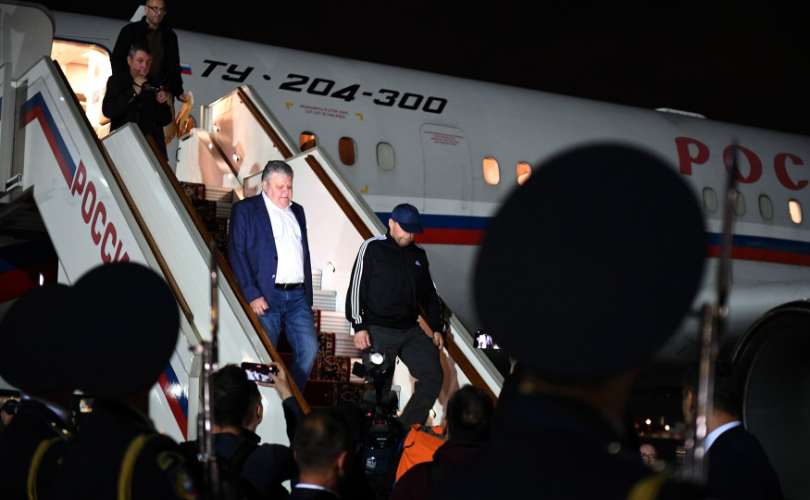
The prisoner exchange took place on an airbase in Ankara, Turkey. Representatives from the Turkish government were present, along with officials representing both the United States and Russia.
Among those released to the U.S. side were:
Evan Gershkovich, a journalist for the Wall Street Journal. He was charged and held in custody beginning over a year ago in Yekaterinburg, Russia, on espionage charges, despite continuing denials from U.S. as swell as newspaper officials. The Russian judiciary said he had been collecting Russian secret information regarding a defense contractor which was engaged in manufacture and maintenance on Russian military materiel. He was eventually found guilty of those crimes and sentenced to 16 years in prison on July 19, 2024.
Paul Whelan, a former U.S. Marine. He was taken prisoner by Russian security personnel in 2018 and charged with espionage. Two years after his capture he was sentenced to 16 years in a prison in Moldovia, located south of Moscow.
Alsu Kurmasheva, a Russian-American journalist who worked as a reporter for Radio Free Europe/Radio Liberty, a U.S.-government funded news enterprise. He was charged with publishing stories which the Russian government said included lies about the Russian army and its readiness for combat. On July 19, 2024, he was sentenced to 6 and a half years in prison for those alleged crimes.
Vladimir Kara-Murza, Jr., an activist for the Russian opposition. He was arrested on charges of treason and spreading falsehoods about Russian military forces in 2022. Most of those charges arose after he spoke to the Arizona House of Representatives in March 2022, shortly after the Russian invasion of Ukraine. He was arrested for what he said there upon returning to Russia afterwards. In 2023, Kara-Murza was convicted of those charges and sentenced to 25 years in prison.
As part of the arrangements, Russian also released to U.S. custody three Russians who were allies of Alexei Navalny, the prominent Russian dissident and former leader of the Russian opposition who died of mysterious causes in an Arctic prison in February 2024. Navalny was also originally to be part of the exchange deal.
The three allies of Navalny who were released were Ksenia Fadeyeva, Vadim Ostanin, and Lilia Chanysheva, who formerly led Navalny’s offices in Tomsk, Barnual, and Bashkortostan, respectively. Chanysheva had been serving a 9 ½ year sentence for her crime of aiding and abetting Navalny. Fadeyeva was sentenced to 7 ½ years in prison for her role.
Some of the more prominent prisoners released to Russia as part of the exchange were:
Vadim Krasikov, a Russian assassin was convicted for the murder of Zelimkhan Khangoshvili, a Chechen rebel, in a public park in Berlin, Germany, in 2019. The German court involved found Krasikov likely shot and killed Khangoshvili at the direction of the Russian Federal Security Service (FSB). Up until yesterday, Krasikov had been serving a life sentence for the murder.
Anna Dultsova, a Russian expat who lived in Slovenia and who was convicted of acting as a “deep cover” spy working on behalf of the FSB.
Vadim Konoshchenok, who had been recently extradited to the United States from Estonia, where he was being held in connection with money-laundering and providing highly sensitive American electronics systems to the Russian military.
Roman Seleznev, head of a noted Russian cyberattack and hacking syndicate. He was arrested in 2014 in the Maldives, then tried later on charges of identity theft, wire fraud, and a cyberattack which eventually affected thousands of American companies. He was eventually sentenced to 27 years in prison for his crimes.
Vladislav Klyushin, another cybercriminal with strong ties to the Kremlin. He was arrested in March 2021 in Switzerland on charges of hacking U.S. computer networks, and by doing so gaining access to sensitive corporate information. As outlined in those charges, he used that data to secure over $93 million in illegal profits through related securities trades. He was extradited to the U.S. in December 2021 and eventually found guilty.
Arranging the prisoner exchange was a complex issue, involving multiple countries and permissions to release those involved rising to the highest levels of government.
In Germany, for example, Chancellor Olaf Scholz was deeply involved going back to February 2024 in authorizing the trade of FSB assassin Vadim Krasikov, who was in prison in Germany, with the original intent of swapping him for Russian opposition head Alexei Navalny. After Navalny died suddenly in the Arctic, for a while Scholz was reluctant to let such a high-visibility criminal out of prison. But after sufficient arm-twisting from the White House and rearranging which targets might be released from Russia in return for Krasikov’s freedom, the deal was eventually done.
Russia had previously indicated that the overall prisoner exchange plan would likely never happen unless Krasikov was part of the deal.
A similar exchange involving the government of Slovenia and the U.S. eventually resulted in the release of Anna Dultsova, a spy who Russia considered of high value, eventually allowed for her being part of the exchange deal yesterday.
In comments made from the White House yesterday, Joe Biden called concluding the prisoner exchange arrangements “a feat of diplomacy and friendship”, which eventually brought back to the U.S. and freed others individuals the U.S. felt from the beginning were wrongfully charged and imprisoned. And although he acknowledged doing so might encourage further charges and imprisonments of others, Biden declared the result well worth the risks of that, and the consequences of releasing Russian prisoners who had been convicted of numerous heinous crimes.
“The demands … required me to get some significant concessions from Germany, which they originally concluded they could not do because of the person in question,” Biden explained, as he described at a high level what had to be done to arrange with German Chancellor Scholz to release Krasnikov from its prison. “But everybody stepped up. … And it matters — to have relationships really does matter to do these things.”
In a separate briefing, White House National Security Advisor Jake Sullivan emphasized the complexity of negotiations over the sizeable group of individuals released from Russia, the U.S., and other western countries.
“Not since the Cold War has there been a similar number of individuals exchanged in this way, and there has never, so far as we know, been an exchange involving so many countries, so many close U.S. partners and allies working together,” he said. “It’s the culmination of many rounds of complex, painstaking negotiations over many, many months.”