
Less than two weeks ago the Bureau of Labor Statistics released data showing monthly nonfarm hiring had slid from June’s growth of 179,000 to just 114,000 last month.
When that news was released, it sent shock waves through the stock market, both because of the 36.3% decline in employees added to American payrolls, and by pronouncements by analysts saying this fall – which was part of a long-term but up to this point relatively slow decline in new hires added – could be a bellwether for what the rest of 2024 might be like.
But after yesterday’s release from the Commerce Department’s Census Department, signs appear clear for now at least that consumer confidence to spend – and spend big – is still surprisingly strong. And since roughly 70% of the U.S. Gross Domestic Product comes from consumer spending, that sends a strong message that the immediate chances of a recession are far lower than many were projecting.
According to the latest retail business report, total spending on Retail and Food Services rose from $702.9 billion in June 2024 to $709.7 billion for July, based on seasonally adjusted figures. That is a 9.7% monthly increase, and the highest month-to-month change in retail spending since a full two years ago, when the U.S. economy was just crawling out of the deep pandemic recession and large gains were to be expected.
For the first seven months of 2024, total retail spending reached $4.86 trillion. That is a 2.9% increase from the same period for 2023.
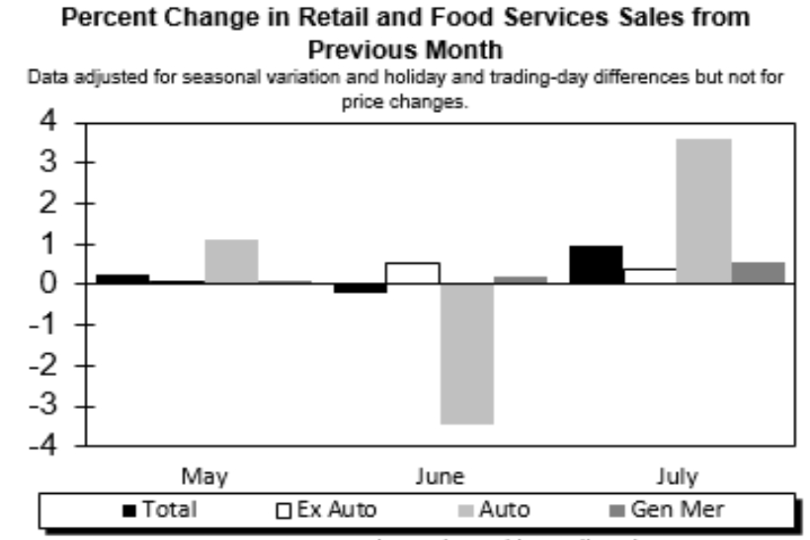
Leading the country’s sales growth last month from an absolute dollars’ basis was a strong turnaround in the Motor Vehicle & Parts Dealers segment. After declining by 3.4% from May to June with net sales that month running at $129.0 billion, July bounced back to $133.6 billion, for a net growth of 3.6%.
Coming in second was the Nonstore Retailer category, which includes ecommerce as a principal component. It scored $122.7 billion in sales, up just slightly from June’s $122.4 billion.
Food Services and Drinking Places were the third biggest contributor to retail sales last month. This category brought in $94.7 billion this time compared to $94.4 billion two months ago.
In fourth place were Food & Beverage stores. This is comprised of grocery stores as well as outlets selling beer, wine, and liquor. Sales in this category went from $82.9 billion in June to $83.7 billion in July.
Next in line was the General Merchandise area of the retail economy, with net sales growing from $75.4 billion to $75.8 billion on a month-to-month basis. This category includes department stores, warehouse clubs and supercenters, and all other nonspecialized retail shopping outlets.
Gasoline Stations contributed the sixth-largest amount of retail revenue for July. The number this time rose only slightly, from $52.5 billion for June to $52.6 billion last month.
Building Material and Garden Equipment and Supplies Dealers saw their revenues grow from $40.8 billion to $41.2 billion.
Also growing just slightly was the Health & Personal Care store area. It rose from $36.8 billion to $37.1 billion.
Clothing and Clothing Accessories stores, which include men’s clothing, women’s clothing, family clothing, and shoe sales outlets, saw their revenues decrease by a marginal amount, from $26.25 billion to $26.24 billion.
Furniture and Home Furnishings store sales were mostly flat as well. Revenue totals for this category went up from $11.05 billion to $11.11 billion last month.
The Sporting Goods, Hobby, Musical Instrument, and Book Store segment brought in $8.165 billion in revenue. This is down just a bit from June’s $8.224 billion.
Electronics and Appliance Stores contributed $7.973 billion in sales for July. That compares to $7.847 the previous month.
The remaining catch-all category, Miscellaneous Store Retailers, saw their revenues total to $14.843 billion, down from a contribution of $15.231 in June.
While the overall retail sales growth was good, that automobile and related goods were responsible for much of the jump this time could suggest this type of growth could be a one-time thing.
Other analysts, such as KPMG Chief Economist Diane Swonk, see it as evidence of more selective buying, and using consumers’ aggregate spending power to seek out the most cost-effective places to make purchases right now.
“Consumers are still spending,” she said in a statement yesterday. “They’re saying, ‘I’ve had it with high prices’, and are making trade-offs where they can.”