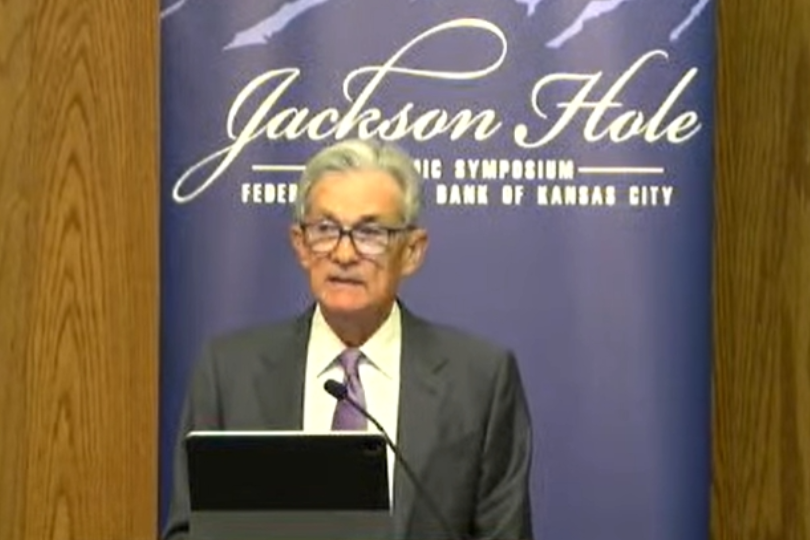
In a major policy address before central bankers and the finance industry at the Jackson Hole Economic Symposium held in Wyoming yesterday, Federal Reserve Board Chair Jerome Powell said what bank regulators, credit agencies, corporations, and the public at large had been waiting for. Prime bank lending rates are finally about to come down.
“Overall, the economy has continued to grow at a solid pace,” he said, probably with a quiet sigh of relief because it now appears the fiery economic growth, hiring, and inflationary stimulation which took off starting in 2021 after the pandemic period ended has finally cooled.
“The upside risks to inflation have finally diminished, and the downside risks to employment have increased,” he continued. “As we highlighted in our last FOMC [Federal Open Market Committee] statement, we are attentive to the risks to both sides of our dual mandate. The time has come for policy to adjust. The direction of travel is clear, and the timing and pace of rate cuts will depend on incoming data, the evolving outlook, and the balance of risks.”
“We will do everything we can to support a strong labor market, as we make further progress towards price stability,” he went on. “With an appropriate dialing back of policy restraint, there is good reason that the economy will get back to 2% inflation while retaining a strong labor market.”
Though the choice of language was measured, the policy shift for the Fed was clear. Interest rates are about to come down.
Those will be the first Federal Reserve Board bank lending rate cuts issued since March 2020. Those were instituted as a means of stimulating an economy which was about to go into major stagnation as the U.S. joined the world in what many now see as a far too restrictive period of business shutdowns and forced stay-at-home policies for months for most Americans.
Guiding Powell’s FOMC decisions are what he referred to in his speech as “our dual mandate”. Inflation, which had soared to 9.1% in June 2022, has now fallen to 2.9% for the month of July. The labor market, the Fed’s other major focal point, continues to hire but as far lower rates than in recent years. Last month the economy generated just 114,000 new nonfarm hires, down from a monthly peak over four times that not long ago. The Bureau of Labor Statistics also announced this week it had revised this year’s total new job growth downwards by 800,000, based on new more accurate payroll data provided through multiple sources. Unemployment is also now up to 4.3%, significantly up from just months ago.
As to when the first rate cuts might happen, most economists are betting this will; happen when the Fed holds its monthly rate analysis meeting in mid-September.
The principal motivation for getting a first cut on the table appears to be the substantial slide in job growth. As Powell said in another part of his talk, the rate at which new positions are being created has experienced an “unmistakable” change in pace, even though – not yet – in direction.
“We do not seek or welcome further cooling in labor market conditions,” he told his audience.
Reaction among industry analysts to Powell’s comments was mixed, which probably echoes the nature of the conversations the FOMC group will be having in just a few weeks.
Chief Economist Ian Shepherdson at Pantheon Macroeconomics supports the decision Powell appears to be telegraphing but argues the U.S. central bank has “waited far too long”.
“Policymakers have been so determined not to be caught out by unexpected inflation again that they have waited until the risk has become vanishingly small,” he said in a statement to the press yesterday following Powell’s comments.
In contrast, Michael Strain, the Director of Economic Policy Studies at the American Enterprise Institute, a conservative think tank, argues now is now the time to make the cuts simply because inflation remains well above the 2% goal the Fed has set for this metric. As he observed after carefully parsing Powell’s choice of words as he took the stage in Jackson Hole, the Fed Chair described the job market as having only “softened” but not yet “soft”.
“Rate cuts are certainly in our future, but they may not be appropriate until 2025,” Strain concluded.
The stock markets responded yesterday a bit more positively to Powell’s comments. All three of the major stock indices, including the Dow-Jones Industrial Average, the S&P 500, and the NASDAQ composite, rose by 1% as the market closed.