Maduro Doubles Down on Opposition Crackdowns with Hardline Interior Minister Appointment and Key Arrest
Lead StoryRebellion-Transformation
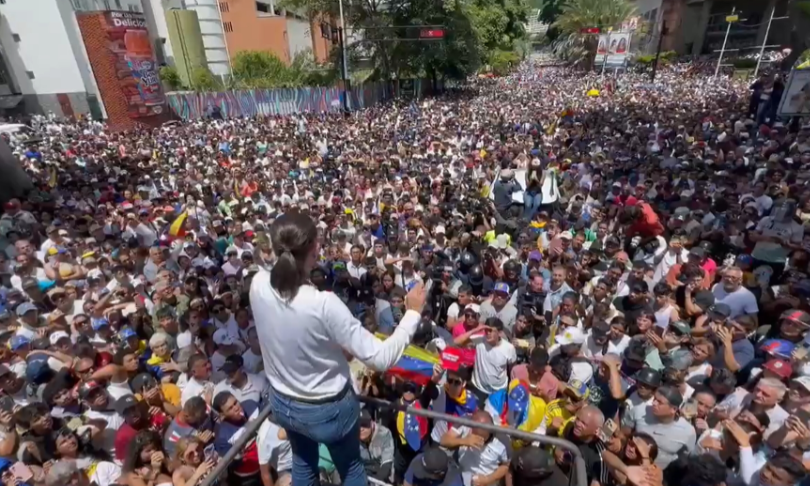
Despite extensive evidence supporting the claim that opposition candidate Edmundo González won the July 28 presidential contest by a ratio of 65% for him and approximately 31% for Maduro, the current president is taking every possible step to solidify his unlawful position of power in the country.
The day after the votes were counted, the Platforma Unitaria, the centrist and pro-business political party founded by María Corina Machado, who the incumbent Maduro successfully pushed out of the way as the opposition leader who led the anti-Maduro campaign this time, announced that González had won the election by a ratio of over 2-to-1. As evidence for that claim, González and Machado revealed they had copies of voting results from over 80% of the nation’s roughly 30,000 polling places.
A day later, the national election commission, a government-controlled organization run by Maduro’s cronies, announced Maduro was the certified victor. With 80% of the ballots reportedly counted, it declared Maduro received 51.2% of the vote and González only 44.2%.
The national election commission provided no proof of its assertions, something which should have been easy had it been the truth. With this clearly coming down as an outright lie designed to keep the socialist Maduro, head of the United Socialist Party of Venezuela (PSUV), in power despite the people having rejected him and his corrupt leadership by a unavoidable majority, there was no need to waste time with proof. The election commission and Maduro simply said the words, and this was the new truth in the country.
Protests exploded across the nation demanding that Maduro honor the results of the election.
The leaders of many nations, including notably neighboring Brazilian President Lula da Silva and Colombian President Gustavo Petro, have also refused to accept Maduro’s assertion that he legitimately won the election, and have not recognized him as the president-elect.
Maduro’s government then submitted the data it claimed proved he won to the Venezuela’s Supreme Tribunal, the highest court in the country. That tribunal invited González to attend hearings held in secret the week of August 12 to review the data. Since Maduro’s military and police thugs had already begun detaining and arresting hundreds of individuals who had taken to the streets to demand Maduro to accept his election loss, González and party head Machado made the decision to stay away from the hearings. They knew they and any associates with them would be at high risk of being arrested themselves and possibly made part of the vast numbers of “disappeared” anti-Maduro activists the government had either jailed or potentially killed.
The Supreme Tribunal swiftly rubber-stamped the position of the national election commission. Maduro once again celebrated his victory, but this time built on the official approvals of the Tribunal and the national election commission as an excuse for an even more thorough and violent oppression of the public in general. It said it needed to do so to keep the peace, when in fact it was doing so to minimize the chance public supporters of the would revolt against the Maduro administration and a civil war possibly to break out.
In the month since the election, estimates are that the increasing militant Maduro government has seized between 1,600 and 2,400 protesters and various leaders of the opposition.
Some were taken captive on the day of the election itself, when police authorities kidnapped those who were already seen as aiding the opposition cause, some even by simply sitting in at polling stations and ensuring the ballots cast there were properly counted. Others were taken into custody at the many protest sites which emerged across Venezuela.
The government is also now actively surveilling social media messages ordinary citizens post and stopping people on the streets to search their phones. It is said that if the police find an individual has put up anything related to the opposition protests, or in support of either González or Machado, they will be arrested on the spot.
This week the Venezuelan government escalated these activities further.
On August 27, Maduro’s “secret police” arrested Perkins Rocha, the lawyer who represents both the Platforma Unitaria party of both González and Machado, as well as Vente Venezuela, another political party which has stood in opposition to Maduro throughout the entire election campaign and since the bogus election results were declared at the end of July.
The information that Rocha was seized, by unidentified agents of the Maduro administration and by force, came initially from Vente Venezuela. There has been no official statement from Maduro or his government confirming Rocha’s capture.
María Corina Machado spread the word about Rocha’s kidnapping in a social media post on X. She called Rocha, one of her closest friends, “a righteous, brave, intelligent and generous man”
“They want to vanquish us, distract us and terrify us,” Machado wrote in response to what happened to Rocha. “We will continue to move forwards, for Perkins, for all the prisoners and those being persecuted, and for the whole of Venezuela.”
Later the same day, Maduro announced a significant realignment of his cabinet. As part of that, he named Diosdado Cabello to be his new Interior Minister. As part of that appointment, Cabello, a 61-year-old former soldier and noted for his hardline repressive tactics in support of the Maduro government for years, will now oversee the entire Bolivarian national police force.
Cabello is now also in control of Sebin, the national intelligence service. Known as the country’s “political” police enforcement entity, it was originally established in its current form in 2013, after being first put in place in 2010 after the restructuring of DISIP, the National Directorate of Intelligence and Prevention Services, under the auspices of the government of former President Hugo Chávez. It is the organization which is also responsible for general surveillance of the public through all means, including monitoring of social media and sending operatives under cover to protest events.
Sebin has been charged by human rights organizations for multiple human rights violations, including beating and jailing of journalists, members of opposition political parties, and ordinary citizens. It is also alleged to be the architect of the murders of multiple political opponents since it has been in existence.
Cabello’s ascension to the position of Interior Minister now puts him in charge of everything he needs to support the transition of Maduro’s government to a full police state.
Up until he was appointed to this role, Cabello helmed a national talk show televised on Venezuelan state-owned television. The show goes by the name Con El Mazo Dando, a colloquial phrase which translate as “Coming Out Swinging”. Cabello used the show to belittle and rage against Maduro’s political opponents.
Since the July 28, Cabello has continuously verbally bludgeoned both González and Machado for their continued insistence that González beat Maduro in the July election. He calls González a sniveling, cowardly “rat”, and Machado as an anti-government “witch”.
Despite the significance of Cabello’s new appointment and Rocha’s capture, yesterday María Corina Machado released a defiant audio message to those supporting her and González and encouraging them to have faith that the will of the people will eventually prevail.
“Today I can’t tell you the exact moment at which we will claim victory,” she said. “But what I can tell you, with absolute conviction, is that the destiny of this struggle is the liberation of Venezuela.”