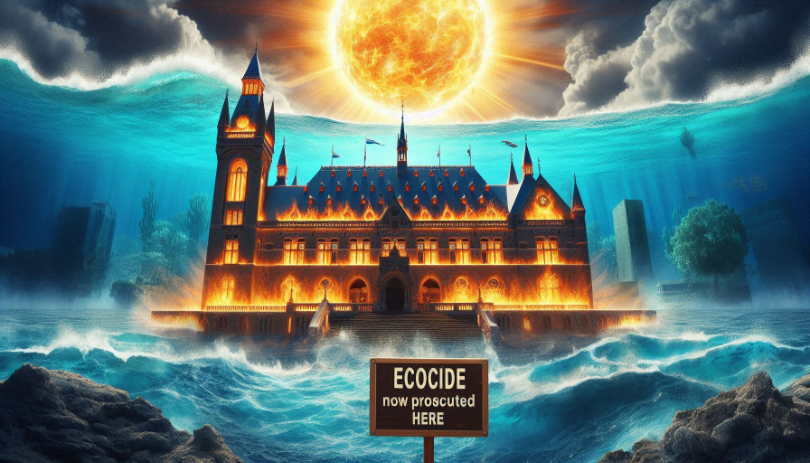
On September 9, Fiji, Samoa, and Vanuatu filed with the International Criminal Court in the Hague, Netherlands, to recognize ecological destruction as an official crime which the ICC can now prosecute.
In their court papers, the three tiny Pacific countries proposed the following definition for the new crime of ecocide. It would cover all “unlawful or wanton acts committed with knowledge that there is a substantial likelihood of severe and either widespread or long-term damage to the environment being caused by those acts”.
If the proposal is accepted, the ICC would be authorized to prosecute individuals and groups across the globe for the new crime. It would work the same way the ICC recently found Israeli Prime Minister Benjamin Netanyahu and Defense Minister Yoav Gallant guilty of war crimes and “crimes against humanity” involving the genocidal war against the Palestinian people since October 7, 2023.
The ICC has this power based on 124 nations having signed onto the Rome Statute which was originally adopted on July 17, 1998, and officially began carrying out its charter on July 1, 2002.
While the crime of ecocide has existed for as long as humanity has put desires for greed, expansion, and wealth ahead of caring for the sustainability of the world and protection of the environment, it has only recently been written into the books as an official prosecutable offense in some countries.
The single biggest shift towards dealing with ecocide as a criminal matter came in April 2023, when the European Union’s Legal Affairs Committee (JURI) voted 22 to 0 to approve adding new ecological crimes to its list of offenses which could be charged and tried at the combined EU.
In its report on its deliberations, JURI gave its own clean definition of the crime of ecocide they propose the EU vote on as a full body as a new criminal offense for the entire European bloc. The definition JURI approved reads as follows:
“When an environmental criminal offence causes severe and widespread, or severe and long-term, or severe and irreversible damage to the quality of air, the quality of soil or the quality of water, or to biodiversity, to ecosystem services and functions, or to animals or plants, such offence should be considered a crime of particular gravity, and sanctioned as such in accordance with the legal systems of the Member States, covering ecocide, for which the United Nations are currently working on an official international definition.”
While this issue continues to be argued as part of a body of changes to EU law, an amendment to JURI’s proposal recommended EU member states add ecocide to the list of criminal acts which may be prosecuted within their countries.
In February 2024, the Federal Parliament of Belgium became the first EU member state to take up this request. It approved amending its criminal statutes to list ecocide in its penal code as a criminal offense. Ecocide in Belgium is now a major crime, with penalties fully in alignment with that designation. Those charged and convicted of making “serious, large-scale, and irreversible crimes against nature” can now be fined €1.6 million (U.S. $1.8 million) and sent to prison for 20 years.
The decision by Fiji, Samoa, and Vanuatu to file for making ecocide one of the crimes the ICC can prosecute came just two weeks after the conclusion of the recent Pacific Islands Forum held in Tonga. Two of the more significant topics explored at that conference were the just-released World Meteorological Organization’s fourth edition of its State of the Climate in the South-West Pacific report, and a joint UN-WMO follow-up study entitled Surging Seas in a Warming World. Both studies came to the same conclusion, that sea level rise caused by global heating and the climate crisis was rising significantly faster in the South Pacific than in much of the rest of the world.
The cause of that global heating is of course the major increases in greenhouse gas emissions, which have pushed solar-heat trapping CO2 concentrations to their highest in hundreds of thousands of years.
If ecocide is recognized as an official crime by the ICC, senior officers of public corporations such as most fossil fuel companies, manufacturers of blatantly destructive pesticides and herbicides, and entities which dump toxic waste into rivers and the sea could be prosecuted individually for their actions, fined, and sent to jail.
The ICC chose to table the recommendations made by the three Pacific Island countries, pending an opportunity for a broader discussion by a committee within the body. Those discussions could take years to reach agreement on adding ecocide to their list of crimes, and then it could be years after that before a first case might be filed under the amended list of crimes the ICC is authorized to prosecute.
Co-founder Jojo Mehta of the Stop Ecocide International activist organization commended the decision by Fiji, Samoa, and Vanuatu to take on the giants in industry for their ecological crimes in this manner. Mehta called the filing with the ICC “a key moment” in this fight for the rights of nature and the world.
“Once it’s on the timetable of the ICC, it has to be discussed,” she explained. “Up to now, member states have not been obliged to address the issue.”
Mehta and others noted that the ICC will likely be heavily lobbied by the fossil fuel industry not to allow ecocide to be added to the list of crimes the Court can prosecute. They have much to lose from ecocide being named a formal crime, not the least of which will be for the first time to hold CEOs of such enterprises liable for the damages they have caused.
Even if ecocide does become an official crime recognized by the ICC, another challenge is that many of the proposed defendants in future prosecutions of that crime are in countries which are not signatories to the ICC Rome Statute, and therefore will more easily evade prosecution for their actions. Those countries which have not chosen to sign off as “members” of the ICC include China, the United States, and India, the three nations with the highest greenhouse gas emissions in the world.
Still the fight to add ecocide as a formal ICC crime will continue and probably finally achieve its goal. Vanuatu first proposed this idea in 2019 and has kept up the pressure ever since. It also has far more to lose than most, with the country’s government already taking steps to create digital archives and plan for the eventual full evacuation of its populace to another Pacific country, since projections show the country could be swallowed up by the Pacific Ocean in less than three decades, thanks to greenhouse-gas-induced climate change.