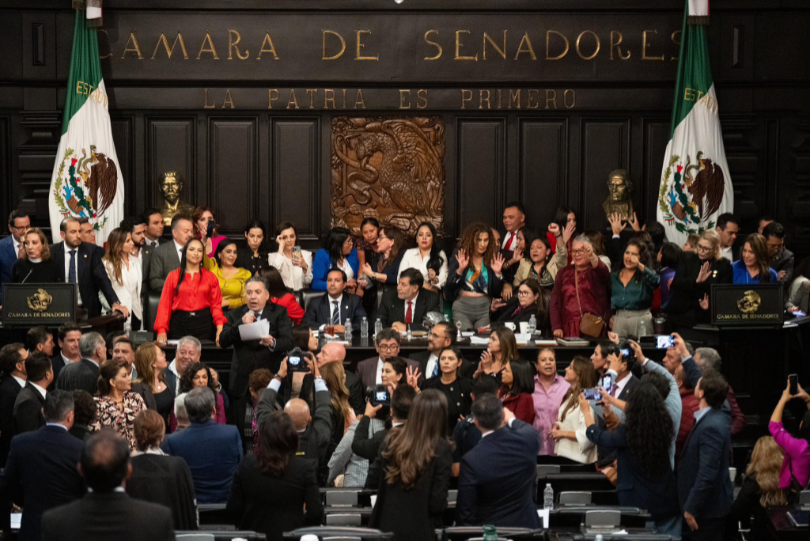
On September 11, the Mexican Senate approved by a vote of 86 to 41 a constitutional change which will require all judges to be elected by a popular vote of the people.
This will enable Mexico in just a few days to become the first nation in the world to elect all its judges by popular vote.
The passage represents a staggering victory for outgoing President Andrés Manuel López Obrador and his Morena party. It is also possibly the last major reform he will push through before his six-year term of office ends on September 30, 2024.
President AMLO, as he is often referred to by many, championed this cause after having often seen initiatives he and his governmental leaders attempted to put in place knocked down or substantially altered by the most senior judges in the country. He declared many times only a substantial change in how judges secure their positions could eliminate widespread corruption in the courts, in a system where all judges are appointed. He and his colleagues have asserted many times that appointed judges often were rewarded their posts in return for agreeing to grant favors in court decisions or providing other forms of kickbacks – sometimes with money changing hands – to those responsible for the appointments.
AMLO’s proposal, the one which the Senate just passed, requires that all judges from the Supreme Court down to the lowest courts in the land can only gain their posts after running for election.
His proposal gained momentum when his handpicked successor, Claudia Sheinbaum, won the presidential election held on June 2 by a landslide. She received 59.5% of the vote. It was an even higher margin of victory than the 53.2% win AMLO secured when he ran for office six years ago.
Sheinbaum is aligned with AMLO on most major policy matters. She has also spoken out strongly in favor of the judicial reform proposal which just passed which, combined with the Morena party having gained seats in the Congreso de la Unión, the Mexican legislature, made getting this constitutional change approved more a matter of time than a question of if it might happen.
With Sheinbaum’s accession to the presidency locked in, AMLO’s representatives in the Congress moved quickly to push the judicial reform ahead.
It did not go through without controversy, however. In parallel with an early draft of the constitutional changes began going through first readings and discussions in the lower house, on August 19 almost all judges throughout the nation’s entire judiciary system went on strike over the move. They formed picket lines which became far more intense this month as the lower house came closer to its vote on the measure.
The judges were striking because they maintained the shift from being appointed to being elected by popular vote would politicize the judiciary in drastic ways. They argued that the ruling party would end up controlling the judiciary far more than the current appointment system would ever have allowed. It would make the judicial branch of the government a puppet of its executive branch, with respect to interpretation of the laws and enforcement of them. Some said it could add a new level of corruption to the judicial system by making it even easier for administrative officials to direct how those elected judges might decide certain cases.
Despite the walkouts, picket lines, and complaints about the repercussions of the proposed changes, the lower house of the Mexican Congress ended up passing the measure by a vote of 359 to 13, just a few votes shy of a 3 to 1 ratio.
Congressman Ricardo Monreal, a prime sponsor of the bill, immediately afterwards declared the lower house win an important step forward for the Mexican people.
“We believe that we will end nepotism, corruption, influence peddling, the conflict of interest, the sale of justice to the highest bidder,” Monreal said.
With the passage in the Senate complete, the constitutional change is now fully approved by the full Congreso de la Unión.
The only other requirements remaining besides that for this to become a formal part of the constitution were for a majority of Mexico's states also to approve the changes in how judges are selected, followed by President López Obrador signing off on the package. As of the end of the day on September 12, 18 of the country's 32 states had already voted in favor of the new approach, so that part was completed quicker than many expected. The president said he will sign the constitutional changes into effect sometime this weekend.
Critics of the measure say setting up the country with judges elected based on popularity rather than appointed theoretically at least based on merit as legal experts will as a minimum dumb down the quality of judges which serve in almost any position within the government. They also point out that judges may end up making decisions based on political expediency so they do not get voted out of office by making unpopular but legally accurate rulings. A third concern is that elected judges may be more wary of reaching so-called “landmark” decisions which could effect large swaths of the populace, industries, or government, than appointed judges.
Experts in Mexican history also point out that when the current Mexican constitution was originally passed in 1917, its framers were adamantly opposed to electing judges, calling the idea an “inexplicable aberration”. They believed judges should be insulated from politics and able to operate independently of whichever political party might be dominant at the time. That independence, they reasoned, required that judges thus must be appointed to their posts and given tenure so they could more easily ride out the storms following their issuance of unpopular though legally valid rulings.
Despite that logic, the Mexican constitution offered considerable leeway over how judges could be put into office. The framers’ desire that they be appointed only after official policy as of the 1990s changed past practices. The process used up until the current change was similar to that the United States follows, with key appointments followed by legislative votes where applicable.
Legal historians noted that courts in the country only began to issue some of their most important and far-reaching decisions starting in the 2000s, because of that change.
Besides mandating the election of all judges, the constitutional changes approved yesterday made substantial changes on other rules specifically affecting the Supreme Court. It has officially changed the requirement for applicable work experience for this caliber of judges from ten years to just five years, added that candidates for these posts must be 35 years of age or older, and provides for a shorter maximum term for them of 12 years.
In all, close to 7,000 judicial positions are affected by the constitutional changes.
The new changes go into effect once they are posted in the official gazette of Mexico. The publication is similar to the United States’ Federal Register, where it posts proposed government agency rule changes and new legislation details.