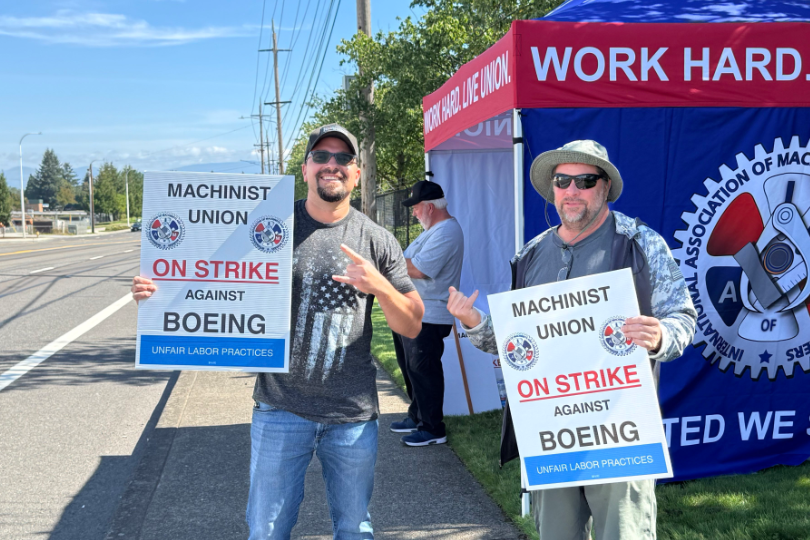
Boeing’s machinists 12:01 am yesterday morning 33,000 workers represented by the International Association of Machinists and Aerospace Workers District 751 (IAM) left their jobs after the union voted in favor of the strike earlier on Thursday.
IAM had been negotiating with the management for some time to do something about wages which had remained only slightly above flat for years, while they watched the senior management of the enterprise pulling in larger salaries and sizeable bonuses. With the war economy involving military aid to both Ukraine and Israel having further buoyed the company’s fortunes during this time, revenues soared in 2023 to $77.8 billion, a 16.79% increase over 2022, a year which had total sales up by just shy of 7% from 2021.
IAM had demanded a minimum 40% pay hike during the next contract, a number which it said would make up for the workers being left behind as the company’s profits soared and management benefited handsomely. They also asked that the next major aircraft the company would manufacture be built in Seattle, after having moved substantial percentages of its work out of that state over the last decade.
As of only a few days ago most thought the likelihood of a strike was low. On September 8, the union said it had reached a tentative agreement with Boeing which it felt would be acceptable to the union. That contract provided a 25% net gain in overall wages for the union members over the next four years. It also included the provision to build the company’s next major new commercial aircraft in Seattle, provided the contract was agreed to quickly. Other terms of the deal increased the company’s share of retirement plan contributions while cutting the amount of money employees had to pay towards healthcare benefits while maintaining coverage.
As a more final form of the contract Boeing said it would accept became clear, employees and union negotiators soured on the deal. Then President John Holden for IAM District 751 recommended its members go on strike. When a vote of those workers was taken on September 12, 96% of the workers voted to reject the contract. It was an overwhelming rejection of what Boeing had offered and well above the minimum 67% vote required for a strike to go forward.
“This is about respect, this is about the past, and this is about fighting for our future,” said IAM president Holden in formal statement announcing the strike yesterday.
The strike will pull workers off their jobs in and around Seattle, with plants in Renton and Everett some of the hardest hit. It is expected to bring aircraft construction to a near complete shutdown as it continues. Shutting down manufacturing will also have a ripple effect on other companies which are part of Boeing’s manufacturing supply chain for the Washington state facilities.
If the strike last more than just days, estimates are that the walkout could cost the company up to $1 billion a week in revenues, something it can ill afford at this time. If it runs for weeks or more it also would affect ongoing negotiations for the sale and supply of new aircraft to customers throughout the world, and drive airlines to consider switching to Europe’s Airbus for deliveries planned over the next several years.
The walkout comes at an especially tough time for Boeing.
Its recent problems began in 2018. After much fanfare over its just released reengineered 737-MAX aircraft which boasted lower costs of operation and better fuel efficiency, one of those jet operated by Indonesia’s Lion Air lost control and plunged into the waters of the Java Sea only 13 minutes after takeoff in October 2018. All 189 passengers and crew were killed in that crash.
Then just six months later, on March 10, 2019, Ethiopian Airlines Flight 302 took a nosedive only six minutes after becoming airborne. Unexpectedly going out of control of its pilot and copilot, it nosedived to the ground in Bishoftu, Ethiopia, breaking apart in a fiery crash that killed 157 people this time, including all passengers and crew once again.
The plane was soon grounded by most major airlines and production on the 737-MAX was suspended by Boeing.
Boeing initially denied responsibility for the aircraft and actively hid critical data and documents from federal investigators attempting to determine the real cause of both crashes.
After further investigation, it was determined both crashes were tied to changes Boeing had made in the plane’s MCAS (Maneuvering Characteristics Augmentation System) software, a system which helps prevent the jet from stalling during climbs, and flaws with sensors which provide data to MCAS. In the case of the Lion Air disaster, it was discovered the pilot did not know MCAS could automatically force the nose of the craft down.
In July 2024, after having been called to accountability for the fatal crashes of two of its reengineered 737-MAX, Boeing took the unprecedented step of pleading guilty to criminal charges filed by the Department of Justice and related to lying to the government. In addition to previously having agreed to pay total fines of $2.5 billion to the DOJ in 2022 for its role in the crashes, in the latest out-of-court settlement Boeing agreed to shell out close to $1 billion in additional penalties. That included $487.2 million in direct penalties and must lay out another $455 million over multiple years to tighten internal safety programs and compliance methodologies.
Boeing also agreed in that settlement to being put on three years’ probation for its action, with strict legal compliance required with all these steps or it will face additional charges. It further had to commit to external oversight over how its engineering and quality control operation are managed.
That plea happened just months after Boeing had to explain why a panel in the fuselage one of the same 737-MAX jets blew out the side of the aircraft in January 2024. After a preliminary investigation, that was proven related to reckless and shoddy workmanship on the manufacturing line. Although final decisions have not yet been made by the FAA regarding what the company must do to address its manufacturing issues and possibly part supply chain problems also have not been determine, the government did order Boeing to cut back on the number of 737-MAX aircraft it makes until the quality control problems and processes involved have been resolved.
Slowing production and quality issues on the 737-MAX were a major contributor to Boeing’s revenue slump of 14% year-to-year for its latest fiscal quarter.
Added to this was was a series of major mishaps, some of which were life-threatening, regarding the company’s flagship Starliner program. Once seen as reinvigorating the company’s commercial space-based business, the Boeing Starliner experienced crippling failures during its first manned mission into space this summer. One set of problems involved helium leaks in its propulsion system while on its way to the International Space Station this summer. The other came when five of its 28 reaction control systems in its thrusters failed to operate as the Starliner moved to dock with the ISS.
Those onboard also reported unusual noises in the capsule after it finally completed its delayed docking. What those were caused by has not been made public at this time.
The issues were considered so serious that the Starliner, which originally would have brought its crew back to Earth not long from now, ended up returning to Earth without anyone on board. The mission directors for the flight were concerned for the safety the craft and those who would be flying within it on the return to Earth. The flight crew will now be forced to wait until 2025 to come back.
SpaceX, one of Elon Musk’s ventures, is expected to gain further market share in the spacecraft and rocket business as a result of Boeing’s Starliner failure.
With potential earnings losses mounting even higher for the aerospace company now that production will either slow or stop because of the crippling strike which began yesterday, Boeing chose to take a conciliatory tone as it hopes contract negotiation talks could restart shortly.
“The message was clear that the tentative agreement we reached with IAM leadership was not acceptable to the members,” Boeing said in a statement released on September 13. “We remain committed to resetting our relationship with our employees and the union, and we are ready to get back to the table to reach a new agreement.”