Sponsored by the Transformer Resilience and Advanced Components program in DOE’s Office of Electricity, the initiative will provide companies with access to national laboratory resources, enabling them to capture market opportunities.
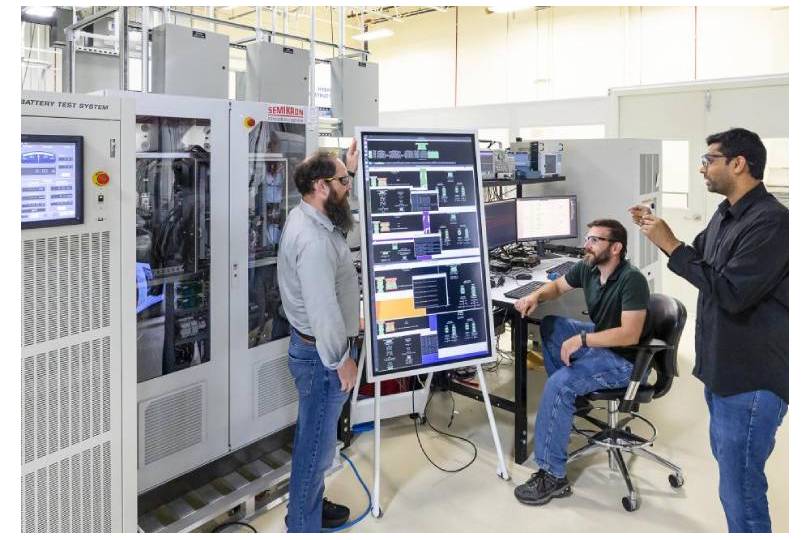
Even startup and small businesses can now easily submit specific proposals for cost-shared research in ORNL’s Grid Research Integration and Deployment Center, or GRID-C. Located at ORNL’s Hardin Valley campus in Knoxville, Tennessee, GRID-C takes grid advances from conception to deployment by industry. The facility is uniquely positioned to incubate and mature technologies from the smallest power module to transmission-level architectures.
The GRID-C technical collaboration program will provide access to more than a dozen labs and test beds for research in power and energy systems, vehicle and buildings science, power electronics, energy storage, sensors and controls, data science, modeling, and cybersecurity. Related facilities on ORNL’s nearby main campus also provide a platform to develop and test new conductor and transmission technologies.
GRID-C researchers previously partnered with large companies through individual agreements. But the technical collaboration program streamlines the process, making it newly accessible to partners with varying levels of resources and for seed projects with a tightly targeted research scope.
The technical collaborations will help businesses reduce the commercial risk of producing or adopting new energy efficiency technologies, simulation methods and other advances. Moving these innovations rapidly to the field will provide broader public benefits, such as improving domestic supply chains, growing technical proficiency within the energy industry and expanding employment opportunities.
Companies eligible to participate in the GRID-C collaboration program must have or develop a focus on advanced components and power stages, advanced converter systems or resource integration and management systems for commercial applications in the U.S.
The technical collaboration program was unveiled in August in Knoxville at the annual meeting of the Power electronics Accelerator Consortium for Electrification, or PACE, an initiative to develop and demonstrate new power electronics technologies by combining the efforts of industry and research institutions. This joint effort speeds up broad adoption of these innovations, which are vital to support grid stability and wider integration of clean energy systems.
UT-Battelle manages ORNL for the Department of Energy’s Office of Science, the single largest supporter of basic research in the physical sciences in the United States. The Office of Science is working to address some of the most pressing challenges of our time. For more information, please visit energy.gov/science.