Philippines Escalates Chinese Conflict with Call to UN to Enforce 2016 South China Sea Ruling
Lead StoryConflict
The surprising news broke during plenary discussions held on September 18 regarding the Philippines’ 2025 General Appropriations Bill, carried out on behalf of the country’s president Ferdinand “Bong Bong” Marcos, Jr.
It came as Nueva Ecija 2nd District Rep. Joseph Gilbert Viola was defending the Department of Foreign Affairs (DFA) proposed P27.392 billion (U.S. $493 million) budget for the upcoming fiscal year.
“The DFA … has a plan to file a resolution with the United Nations General Assembly (UNGA) on the Philippines’ territorial claim in the West Philippine Sea,” he said in response to a specific question about this line item posed during the deliberations.
This follows an earlier action filed in the Philippine House on June 10 by Representative Erwin Tulfo, under which the House formally asked the Marcos administration to sponsor a formal resolution in the UN General Assembly demanding China end its continued usurpation of perceived Philippine rights of way in what it calls the West Philippine Sea. It further asked for the resolution to direct the People’s Republic of China (PRC) to back off from its ongoing Coast Guard and Chinese naval confrontations with the Philippine military and the country’s fisherfolk, who have historically fished in that region for many decades without incident.
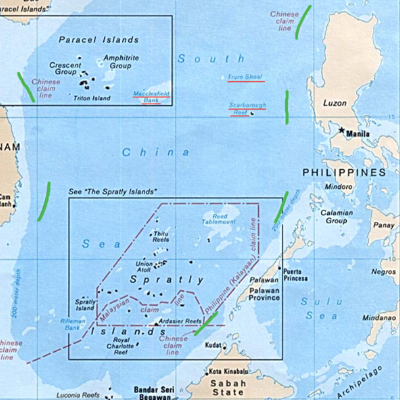
China and the Philippines have overlapping claims in the West Philippine Sea, in which China claims much of it is sovereign territory owned by the PRC and more properly referred to as the South China Sea.
China began acting on its position in the region over ten years ago, seizing portions of the uninhabited Spratly Islands chain and a valued part of it known as the Second Thomas Shoal. It began first by building minor refueling and maintenance facilities for its military vessels traveling through the region. Then it added land areas around the perimeter of some of the Spratlys, installed more involved military defense installation which reportedly include some missile launching capabilities, and built up more advanced deepwater port capabilities.
In doing so, China incurred the anger of more than just the Philippines. It also intruded on similar claims of ownership of international waters’ rights to the overlapping portions of the South China Sea by Vietnam, Brunei, Malaysia, and Taiwan.
During the administration of Philippine President Benigno “Ninoy” Aquino III, who held that office from 2010 through 2016, the Philippines filed a legal complaint with the Hague’s Permanent Court of Arbitration (PCA) in the Netherlands. In that complaint the Philippines argued that the United Nations Convention of the Law of the Sea, a treaty to which all UN members including the Philippines and China are parties to, overrides all past historical considerations among any parties with claims to rights in the open seas. By doing so, the Convention of the Law of the Sea also formally eliminates most oft the arguments China made regarding the Spratlys and adjacent waters.
After reviewing all claims by the Philippines and counterarguments provided by China, the PCA definitively ruled against China in this dispute. In the formal “award” in favor of Manila’s filing, the PCA:
Declared China’s long-standing position that what it calls the “Nine-Dash-Line” region does not belong to it.
“The Tribunal concluded that, to the extent China had historic rights to resources in the waters of the South China Sea, such rights were extinguished to the extent they were incompatible with the exclusive economic zones provided for in the Convention,” the PCA wrote.
Rejected of China’s claims that the Spratly Islands and other land features within the South China Sea are legally land territories, and therefore not subject to the provisions of the UN Convention of the Law of the Sea. The PCA ruled that, according to legal definitions in the Convention, none of the Spratlys are legally islands, based on how they are submerged at high tide. It further ruled that China’s modifications of the Spratlys and neighboring reef structures to cause less of them to be submerged them doe not negate the intent and stipulations of the Convention.
Ruled China had acted in direct violation of clear sovereign rights held by the Philippines on multiple counts.
“Having found that certain areas are within the exclusive economic zone of the Philippines, the Tribunal found that China had violated the Philippines’ sovereign rights in its exclusive economic zone by (a) interfering with Philippine fishing and petroleum exploration, (b) constructing artificial islands and (c) failing to prevent Chinese fishermen from fishing in the zone,” the ruling explained. “The Tribunal also held that fishermen from the Philippines (like those from China) had traditional fishing rights at Scarborough Shoal and that China had interfered with these rights in restricting access. The Tribunal further held that Chinese law enforcement vessels had unlawfully created a serious risk of collision when they physically obstructed Philippine vessels.”
Determined that many of China’s rebuilding and reclamation activities in the South China Sea caused substantial and unrecoverable environmental harm, in accordance with a further part of the Philippines’ filing.
The ruling/judgement award was delivered on July 12, 2016. The full text of this important decision is available here.
As expected, China ignored the ruling. It telegraphed that even as the Arbitration panel was reviewing the case, declaring it “will neither accept nor participate in the arbitration unilaterally initiated by the Philippines”, according to the PCA.
The surprise regarding the ruling came instead from the Philippines. The PCA decision was announced just weeks after incoming Philippine President Rodrigo Duterte took office. He immediately announced he had no intention of doing anything about what the PCA had decided. He also said he would not seek help from the United States, a long-term ally of the Philippines, to assist in enforcing the ruling using its warships and military forces.
Duterte saw the U.S. as a force attempting to manipulate the Philippines for its own gain and refused to play into that. What he did instead was to launch six years of appeasement and rapprochement with China. That included ignoring Chinas’ further incursions into the South China Sea, building up of facilities in the Spratly Islands. It also involved an era in which Chinese corporations became active participants in some of the biggest construction projects in the country, such as the Binondo-Intramuros Bridge built in Manila thanks to a $96 million loan from China. Trade also greatly increased between the two nations during this time. While in office Duterte also allowed state-run China Telecom to provide substantial financial backing for DITO a third-party alternative to the country’s two primary telecom giants, Globe and PLDT. DITO has since risen in prominence to become the lowest-cost high-speed internet provider in the country.
All those policies pivoted quickly when Ferdinand “Bong Bong” Marcos, Jr., the son of and financial beneficiary of the notorious brutal dictator Ferdinand Marcos, took office as President in June 30, 2024. Bong-Bong Marcos became president after an election he won in a landslide, thanks to extensive misleading of the public over his own corrupt background, which included having unlawfully never paid taxes on billions of U.S. dollars his father and mother ransacked from the Philippine government in the 1970s and early 1980s.
Since Marcos became head of state in the Philippines in June 2022, he steered the country in a near 180-degree pivot away from Duterte’s close Chinese connections to foreign relations directives pledging strong fealty to the U.S. The shift brought in billions of dollars in U.S. military aid and expansion of U.S. airbases across the Philippines.
As part of the endorsement of Joe Biden and Secretary of State Antony Blinken’s tough anti-China foreign policy, the Philippines also became in many ways a puppet of Washington. Examples of that ranged from the U.S. and the Philippines holding elaborate joint military exercises at sea and on land, such as during the recent “Balikatan” ones in May which simulated what might happen should China breach the country’s beaches in a military invasion.
The Philippines also proved more than willing to confront Chinese Coast Guard ships and armed forces in the South China, even when it meant being attacked by water cannon and being rammed by Chinese vessels. While they were backed into those confrontations by U.S. forces, they put lives and vessels at risk in the equivalent of a physical “bar fight” there is no way the Southeast Asian nation could ever win on its own.
These taunts took a far bigger step forward earlier this week, when U.S. armed forces based in the Philippines announced they would maintain stockpiles of mid-range Typhon defense systems indefinitely. These systems include cruise missiles capable of carrying nuclear warheads which have the range to strike Chinese targets even when launched from Philippine soil. The Typhon systems were ostensibly brought in temporarily for use in the Balikatan simulated combat training. When that happened, even though the missiles were to be around just a short while, China called out the Philippines and U.S. for created an increased regional arms threat to the PRC. Now the missiles will remain for as long as the U.S. decides they will, raising tensions between China and both the U.S. and the Philippines.
With the upcoming plan to ask the United Nations General Assembly to enforce The Hague’s 2016 ruling regarding the UN Convention of the Law of the Sea, the Philippines just thumbed its nose at China again in its most brazen threat action to date.
The General Assembly will likely shelve responding to the request for some time, on the grounds that it has far more serious issues to address regarding the genocidal war Israel is carrying out against Palestinians in Gaza, and in calming the conflict between Ukraine and Russia. The Security Council might also take up the issue, but any resolution condemning China’s actions in the South China Sea would automatically be vetoed by China, which happens to be one of the SC’s permanent members.
In both cases China will come out as the winner of this diplomatic dispute. It will also see no reason to cease what it is doing in the South China Sea. More serious is what China might decide to do to the Philippines in return for taking the highly confrontational move to demand the UN stand beyond The Hague’s 2016 decision.
In the past the PRC has threatened taking stronger commercial actions against the Philippines for its aggressive challenges to Beijing. Those could start with instituting a full blockade on Philippine fisherfolk in the South China Sea, an act which could cause significant economic harm to one of the country’s most important industries. At their worst, Beijing could direct a partial or nearly complete shutdown of business with the Philippines. With China responsible for roughly 23% of the Philippines’ total trade, it is one of the nation’s biggest trading partners. If all that were shut down, everything from retail store supplies to agricultural goods could be drastically affected very fast.