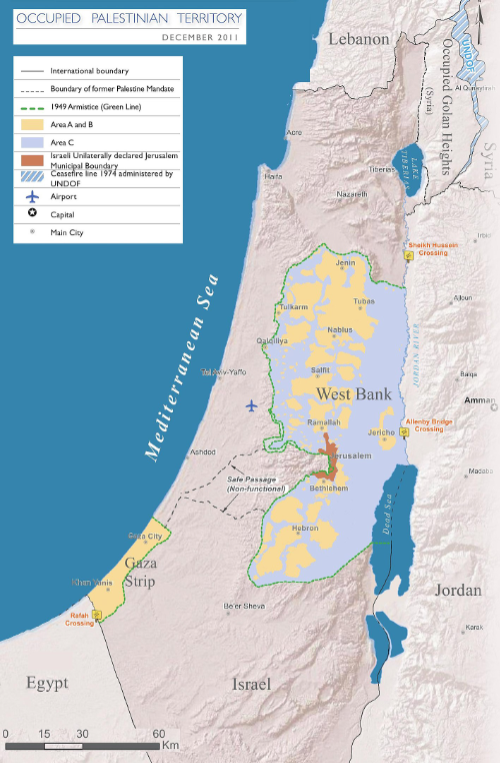
The vote which happened late September 18, was for a measure authored by the Palestinian delegation and sponsored by others, since it has no authority yet to recommend, debate, or vote on resolutions brought before the General Assembly. It currently holds only observer status in the UN.
It was the first measure put forth on behalf of Palestine since it was only this month granted permission to be seated alongside the rest of the UN’s regular members.
The UN summarized the landmark resolution succinctly:
“With a recorded vote of 124 nations in favor, 14 against, and 43 abstentions, the resolution calls for Israel to comply with international law and withdraw its military forces, immediately cease all new settlement activity, evacuate all settlers from occupied land, and dismantle parts of the separation wall it constructed inside the occupied West Bank.
“The General Assembly further demanded that Israel return land and other “immovable property”, as well as all assets seized since the occupation began in 1967, and all cultural property and assets taken from Palestinians and Palestinian institutions.
“The resolution also demands Israel allow all Palestinians displaced during the occupation to return to their place of origin and make reparation for the damage caused by its occupation.”
The basis for the resolution was a formal advisory opinion issued by the United Nations’ International Court of Justice on July 19. That opinion was in response to a request by the UN General Assembly on December 20, 2022, to review past legal agreements and treaties regarding Israel’s occupation of the Gaza Strip, East Jerusalem, and the West Bank, and render recommendations regarding Israel’s right to control those territories versus Palestinian rights and title to the same lands.
In that advisory opinion, after review of over fifty years of treaties and other agreements covering the matter, the ICJ declared Israel to have engaged in over a half century of illegal occupation of land set aside for the Palestinian people and that it should immediately withdraw from those territories. It said that, in its opinion:
“The State of Israel’s continued presence in the Occupied Palestinian Territory is unlawful;
“The State of Israel is under an obligation to bring to an end its unlawful presence in the Occupied Palestinian Territory as rapidly as possible;
“The State of Israel is under an obligation to cease immediately all new settlement activities, and to evacuate all settlers from the Occupied Palestinian Territory.”
In this, the first United Nations-wide rebuke of Israel’s actions against the Palestinian people and their lands since the 1960s, the resolution passed by the entirety of the General Assembly on September 18, the UN “strongly deplored the continued and total disregard and breaches” by Israel regarding its obligations “under the UN charter [and] international law”.
It further said that Israel “must be held to account for any violations” international law in the Occupied Palestinian Territory, including human rights violations and humanitarian concerns.
It went on to say that the government of Israel “must bear the legal consequences of all its internationally wrongful acts, including by making reparation for the injury, including any damage, caused by such acts.”
To that end, the resolution also called for “the establishment of an international mechanism for reparation for all damage, loss or injury arising from the internationally wrongful acts of Israel in the Occupied Palestinian Territory, and calls for the creation by Member States, in coordination with the United Nations and its relevant bodies, of an international register of damage to serve as a record, in documentary form, of evidence and claims information on damage, loss or injury to all natural and legal persons concerned, as well as to the Palestinian people, caused by the internationally wrongful acts of Israel in the Occupied Palestinian Territory, as well as to promote and coordinate evidence-gathering and initiatives aimed at securing such reparation by Israel.”
The resolution further directed the Government of Switzerland, “in its capacity as the depository of the Geneva convention”, to convene “a Conference of High Contracting Parties to the Fourth Geneva Convention relative to the protection of civilian persons in time of war on measures to enforce the Convention in the Occupied Palestinian Territory, including East Jerusalem”. The resolution asks for this Convention to occur by six months from now.
The measure also directs the UN General Assembly to hold “an international conference under the auspices of the Assembly for the implementation of the United Nations resolutions pertaining to the question of Palestine and the two-State solution for the achievement of a just, lasting and comprehensive peace in the Middle East.”
In addition to these actions, the UN ordered member “States to cease importing products originating from Israeli settlements and to halt the transfer of arms, munitions, and related equipment to Israel in cases where there are reasonable grounds to suspect they may be used in the Occupied Palestinian Territory.”
The 14 members of the Assembly which voted against the resolution were Israel and the United States, along with Argentina, Czech Republic, Fiji, Hungary, Malawi, Micronesia, Nauru, Palau, Papua New Guinea, Paraguay, Tonga, and Tuvalu.
In defending its rejection of the measure, Linda Thomas-Greenfield, the American ambassador to the United States, said in a formal statement that:
“The United States also respects the important role of the International Court of Justice in advising the UN General Assembly, and in helping peacefully settle disputes. However, adoption of a one-sided resolution that selectively interprets the substance of the ICJ’s opinion, does not advance what we all want to see, and that is progress toward two-states, living in peace, side-by-side.”
To be clear, the UN measure demanding Israel’s exit from occupied territories was far from a selective interpretation of the ICJ’s opinion. The measure in fact quoted the ICJ advisory ruling accurately and without distortion.
The 43 nations which abstained were Albania, Australia, Austria, Britain, Bulgaria, Cameroon, Canada, Costa Rica, Croatia, Democratic Republic of Congo, Denmark, Dominican Republic, Ecuador, Ethiopia, Georgia, Germany, Guatemala, Haiti, India, Italy, Kenya, Kiribati, Liberia, Liechtenstein, Lithuania, Moldova, Nepal, Netherlands, North Macedonia, Panama, Poland, Romania, Rwanda, Samoa, Serbia, Slovakia, South Korea, South Sudan, Sweden, Switzerland, Ukraine, Uruguay, and Vanuatu. A notable surprise within that group was Germany, which had remained until recently a strong ally of Israel and defender of what it calls Israel’s “right to defend itself” in the mass genocide of the Palestinian people in Gaza and now beginning in the West Bank.
As for those who voted in favor of the resolution, Spain and France supported the measure, indicating a strong shift against Israel in at least part of the European continent may be on the way.
Japan also voted in favor of the resolution despite it almost always acting in lockstep with the United States on matters like this. Its representative said it voted for the measure because of the need to enforce international law.
As expected, Israel angrily attacked the measure and those who voted for it.
In a fiery statement after the resolution was adaopted, Israel’s Foreign Ministry said, “The political theater called the General Assembly today adopted a distorted decision that is disconnected from reality, encourages terrorism and harms the chances for peace.”
““The Palestinian Authority that initiated the decision is not interested in peace, but in defaming Israel. The Palestinian Authority is conducting a campaign whose goal is not to resolve the conflict but to harm Israel,” the Ministry continued. “Israel will respond accordingly.”
The vote this week to oust Israel from the territories it is illegally occupying will not result in Israel's pulling out of those regions, at least not with the United States, its financier-in-crime, backing it. But it is already further solidifying the opposition to Israel as a ruthless and murderous criminal state, and that alone could make all the controversy about this vote worth it.