Israel Ratchets Up Reckless War with Lebanon as UN’s Member States Condemn Global Inaction to Stop It
Lead StoryConflict
The opening comments by UN Secretary-General Antonio Guterres set the tone and principal message which dominated the first day of the General Assembly gathering in New York yesterday and in press interviews leading up to it.
“We are in an era of great transformation, facing challenges like we have never seen before, challenges that require global solutions,” Guterres told his audience of world leaders, ambassadors, and their entourages. “And yet geopolitical divisions are deepening. The planet continues to warm. Wars are raging with no end in sight, and nuclear threats and new weapons cast a dark shadow. We are approaching the unimaginable, a powder keg that will engulf the entire world.”
The Secretary-General spoke of the triad of ongoing bloody wars which he attempted to hint at having solutions if the world worked together, but which as he outlined the truth of what was happening on each front his tone came across as a mix of despair at where things were heading and disgust at those who could act to bring peace but refuse to.
Those wars include the one consuming the lives of many thousands in Sudan for much of the last decade and between Russia and Ukraine now for over a year and seven months.
Yet even those horrific abuses of international law are trumped in scope and mindset by the latest phase of Israel’s genocidal slaughter of the Palestinian people in Gaza which began October 7, 2023, has already spread into most of the West Bank, escalated regionally with assassinations and other war crimes carried out in Syria, Lebanon, Iraq, and Iran, twisted into the recent blatantly terrorist joint Mossad and Israeli Defense Forces actions in Lebanon which caused thousands of pagers, laptops, and other electronic devices to explode, maim, and kill innocent children and adults alike, and is already spreading across the Middle East into a much broader war with as Israeli IDF fighter jets and missiles destroy apartments, office buildings, and targeted vehicles.
“The time has come for a just peace based on the United Nations Charter, international law, and UN resolutions,” Guterres declared.
It is also time, Guterres added, for a radical reform of how the United Nations manages its principal charter of keeping the peace globally, especially as a greater number of countries act as and believe that “they can trample international law".
“They feel … they can ignore international human rights conventions or decisions of international tribunals. That they can show contempt for international humanitarian law, invade other countries, devastate entire societies, or completely disregard the well-being of their own nation and nothing will happen to them,” Guterres went on.
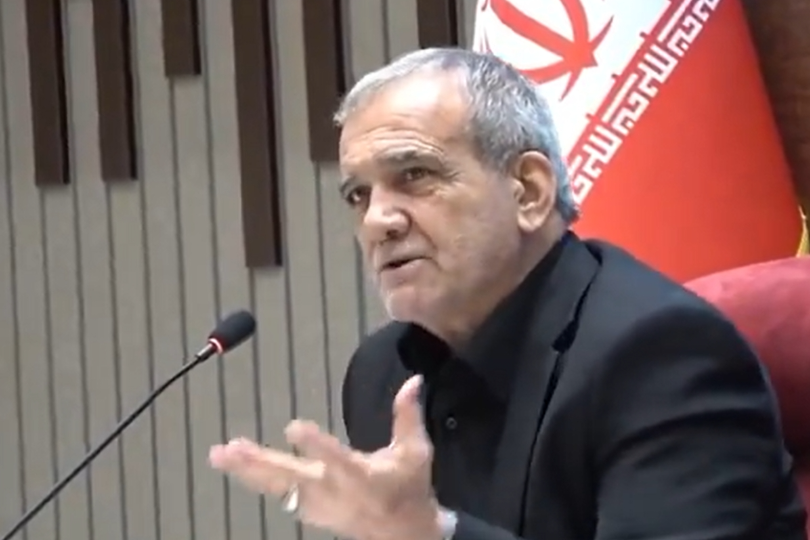
Prior to the event, Iran’s new President Masoud Pezeshkian, who ran for office on a platform promising better cooperation with the rest and a drive for peace in the Middle East, openly slammed the words and growing lists of war crimes committed by Israel directly and in collusion with the United States, who supplies most of its weapons.
In a briefing with reporters on September 23, Pezeshkian began by reminding them of Israel’s assassination in July of Hamas political head Ismael Haniyeh via a bomb planted in his quarters, while Haniyeh was attending the new president’s inauguration in Tehran. Israeli forces infiltrated the facilities there and planted a bomb to be detonated later, in classic terrorist fashion. They murdered Haniyeh on foreign soil in gross violation of international law and at the same time as they were telling the world they were deeply interested in a ceasefire agreement they were negotiating with Haniyeh as the lead negotiator.
“The criminal and terrorist Zionist regime martyred our dear guest in our house and made us bereaved,” said Iranian Supreme Leader Ayatollah Khomeini in a formal statement released at the time.
By carrying out this unforgiveable crime, Khomeini went on, Israel “also prepared the ground for a harsh punishment for itself.”
“[Iran] will defend its territorial integrity, dignity, honor, and pride, and will make the terrorist occupiers regret their cowardly act,” President Pezeshkian told the world at that time.
American diplomats scrambled to find a way to “de-escalate” the crisis Israel’s assassination of Haniyeh triggered. While every time publicly justifying just about everything Israel does in the Middle East as part of its “right to defend itself”, the U.S. demanded every nation and region Israel continues to attack be the ones who must promise not to escalate the war. That is despite the absurdity of such a request when the U.S. refuses to condemn any act of war or terrorism committed by Israel.
The U.S. also sent envoys to Tehran soon after Iran began issuing threats to respond to Israel’s unforgiveable action. They told Iranian officials peace in Gaza was at hand, with both Israel and Hamas close to signing off on a long-term ceasefire which would stop the war and return prisoners home from both sides.
Iran believed the U.S. So too did much of the world. But none of it was true.
“They told us earlier to prevent a larger war to wait another week or so for peace to be obtained,” Iranian President Pezeshkian told the reporter group on September 23. “Clearly the politicians that lie to us these days … lie to you as well.”
When he took the podium before the General Assembly yesterday, the Iranian leader called for the world specifically to denounce the growing bloodshed in the Middle East and issued a harsh rebuke of both the U.S. and Israel for their joint role in turning the region into a battlefield.
“It is imperative that the international community should immediately stop the violence and bring about a permanent cease-fire in Gaza and bring an end to the desperate barbarism of Israel in Lebanon, before it engulfs the region and the world,” he said.
Next, in a surprise statement, the new Iranian president said, “Here I want to address the American people.”
“It is not Iran that has established military bases along your borders,” he explained in a surprisingly blunt assessment of the duplicity of American actions in the Middle East. “It is not Iran that has imposed sanctions on your country and obstructed your trade relations with the world. It is not Iran that prevents you from accessing medicine. It is not Iran that has restricted your access to the global banking and financial system.”
“It is not we who have targeted your military leaders,” he continued. “Rather, it is the United States that assassinated Iran’s most revered military commander at Baghdad airport.”
In that statement Pezeshkian was referring to when the U.S. military assassinated Senior Iranian Quds Force Commander Qasem Saleimani in 2020 in a drone strike. As with the many assassinations carried out by Israeli forces in foreign territories, this too was a violation of international law and constitutes just one of many war crimes the world holds the U.S. accountable for in the Middle East over the last few years.
The message was clear and intentional, as the new president laid much of the blame for the current turbulence in the Middle East as much on the United States as he does on Israel and its warmonger Prime Minister Benjamin Netanyahu.
Pezeshkian also spoke of his campaign pledge to work together with other world powers to sign a new version of the Joint Comprehensive Plan of Action (JCPOA), which President Barack Obama stewarded forward in 2015 and 2016, and which resulted in lifting of sanctions on Iran while that country scaled back its nuclear development programs.
“Iran agreed to the highest, unprecedented level of nuclear oversight in return for recognition of our rights and the lifting of sanctions within the framework of the JCPOA,” he continued. “Trump’s unilateral withdrawal from that agreement manifested a threat-ridden approach in politics and a coercion-driven strategy in the economic domain.”
“We are ready to engage with JCPOA participants. If JCPOA commitments are implemented fully and in good faith, dialogue on other issues can follow,” he concluded.
Once again, the Iranian president mixed his message here about wishing to work for peace while laying considerable blame on the United States for helping construct the “powder keg” UN Secretary-General Antonio Guterres spoke of as growing ever riskier every day.
It is a message that other world leaders delivered to the UN General Assembly audience throughout the first day of regular meetings this year. The big question now is whether the nations of the world will take the warnings seriously and do something about them.